My double major in history and secondary education has prepared me to be the best history teacher I can be. Studying history at a higher level helped me grow in my critical thinking, analysis, and interpretation skills that I now help my students develop in the classroom. History allows us to understand why our world is the way it is, and my education has equipped me to guide students in exploring the connections between the past and present.
Bachelor of Arts
History
Major | Minor
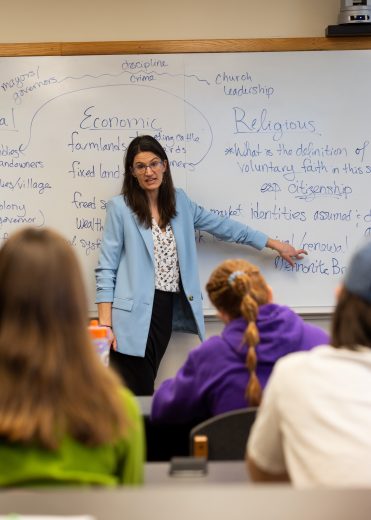
Understand the world by studying the past
Ask hard questions, work in real archives, and graduate ready for many paths, not just one.
The history major at Goshen College treats the past as a way to understand the present and shape the future. You’ll learn to ask critical questions, research in real archives, and tell true stories with empathy and precision.
Studying history here isn’t about memorizing names and dates. It’s about uncovering the stories that define cultures, movements, and everyday people. Here, a small college doesn’t mean a small world: you’ll be able to carry out original research, find internships suited to your career goals and spend a term abroad.

Is history right for you?
This is a major for curious, independent thinkers. If you like to do your own research and tell engaging stories that take other cultures seriously, history is the major for you. History majors stand apart as curious learners and empathetic listeners, prepared for a multitude of post-graduate pathways. Recent graduates work in the justice system in law education, archives & museum curation, public policy and non profit advocacy.
What you’ll study
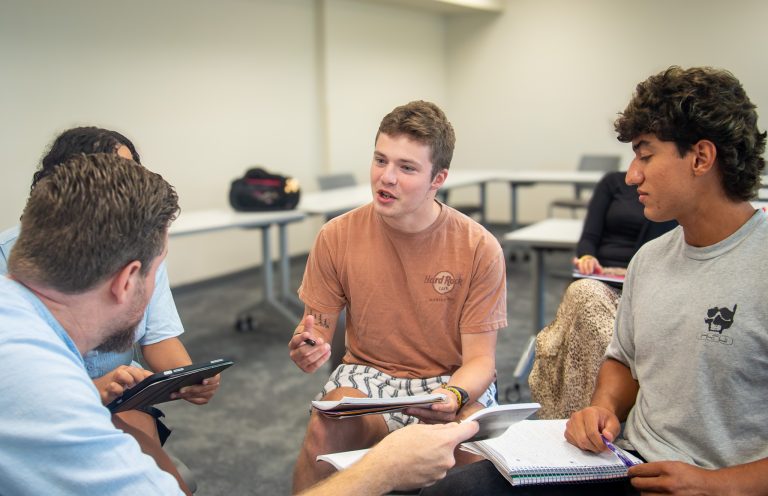
You can customize the major with a focus in a related discipline, such as law, public history, teaching, social sciences or humanities. Every history major completes an internship that supports their academic and career interests. These internship opportunities include: the Elkhart County Historical Museum, local law offices, public defender agencies, advocacy groups and legal aid clinics. Additionally, many students work one-on-one with faculty through the Maple Scholars summer research program, where past students have cataloged oral history interviews, inventoried sources on local Asian-American communities, and collected data from Amish newspapers.
You’ll also study culture and history off campus in courses like “Cultural Perspectives: Chicago to Amish Country” and “Latino Community Histories,” and complete a senior seminar sequence on the craft of the discipline and the integration of faith and history. View the complete program requirements in our catalog.

Emma Thomas '24
Secondary History Teacher
Paying for Goshen
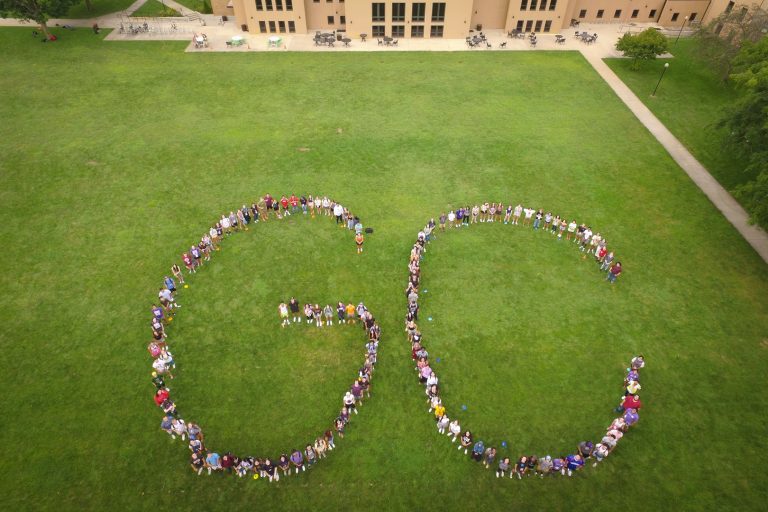
Scholarships make up a large part of Goshen financial-aid packages, which average almost $26,000 per student. To see your own price after aid, run the net price calculator or explore your options at the financial aid and scholarships pages.
Beyond scholarships open to all students, Goshen offers awards exclusively for junior and senior history majors, the Willard and Vera Smith Scholarship and the Oswin and David Gerber Scholarship. Adding history as a minor carries no separate tuition; you simply declare it with your advisor.
Common questions about history major
History majors are prepared for roles like public administrator, foreign service officer, intelligence analyst, lawyer, urban planner, historian and museum curator. Goshen graduates work in the justice system, education, politics, advocacy and beyond, and have done well applying to graduate school in law, humanities, politics and education.
Every history major completes an internship, often with regional institutions such as the Elkhart County Historical Museum, the Goshen Historical Society Museum, or the Mennonite Church USA Archives. Most students additionally spend time abroad through the Study-Service Term. On campus, the Mennonite Historical Library and the Institute for the Study of Global Anabaptism open rich research opportunities.
Yes. Every history major does. You’ll start in Seminar: Historical Thinking, where you learn the methods of historical research, choose your topic and do the initial work. You’ll carry that topic into Seminar: Thesis, where you write the paper and present it. The thesis is yours from the first question to the last footnote.
Not right away. Your first year is Goshen Core and introductory history courses, so you have time to find what pulls you. Concentration coursework begins in your second year. You’ll choose one of five: Social Science, Humanities, Social Research, Public History or Social Studies Education.
Ready to get started?
Philipp Gollner
Professor of US History
Elizabeth Miller
Director of the Institute for the Study of Global Anabaptism
Assistant Professor of History
& Convocation CoordinatorJulia Schiavone Camacho
Professor of History