UV-Vis spectrometers for first-semester experiments, individual mini-fume hoods, individual equipment drawers, full-scale fume hoods for hazardous reagents, safety showers, and eyewash stations.
Bachelor of Arts
Chemistry
Major | Minor
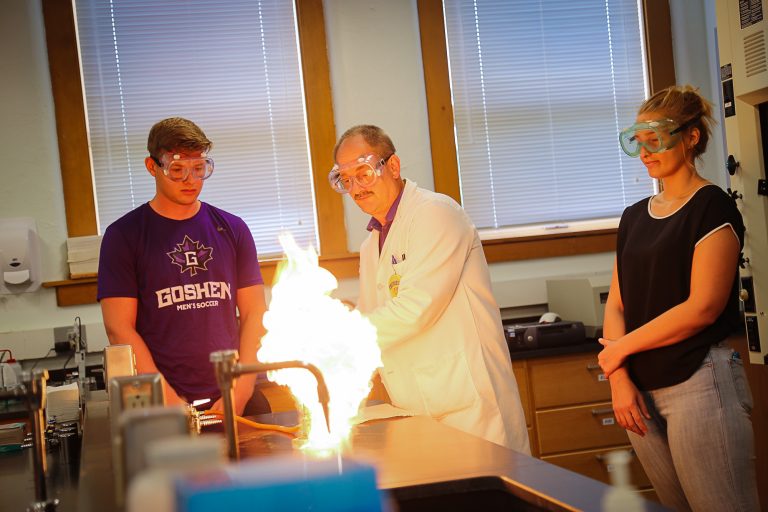
Learn to appreciate a detail-filled world
If you are detail-oriented, logical and analytical, a chemistry major from Goshen College will develop these skills and open doors to top-tier medical programs, advanced research, and high-demand careers. Our four-year bachelor’s degree program blends rigorous coursework with real-world science, preparing you for leadership in healthcare, industry, laboratory research, and education.
You will build a standout resume through hands-on research and internships with regional laboratories, medical centers, and industry partners. The proof is in our outcomes: Goshen College chemistry graduates consistently gain admission to medical and graduate schools at rates significantly above national averages.

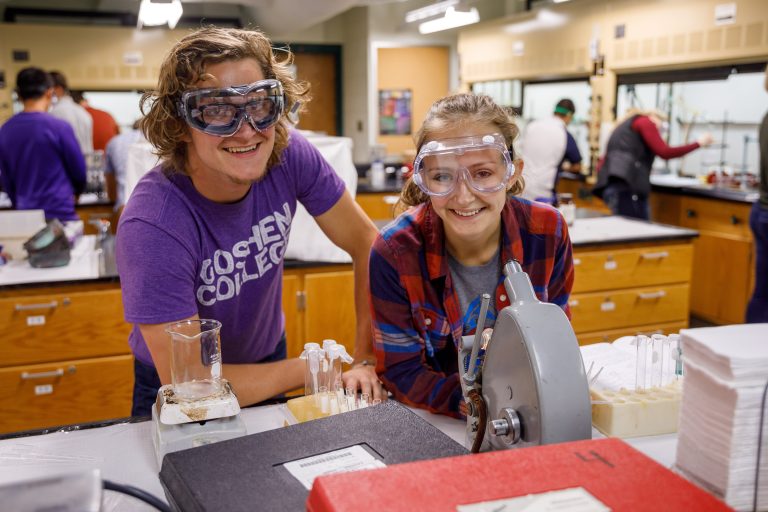
Hands on the instruments, from your first semester
At most universities, advanced equipment like the gas chromatography-mass
Classes stay small enough that your professors know your name and your project. That’s what makes real undergraduate research possible early — and it shows up in the results: Goshen College chemistry students score in the 75th percentile nationally on exit exams.
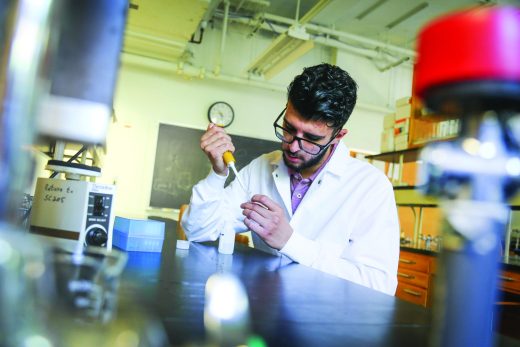
What you’ll study
The major covers the four branches of the field: organic, inorganic, analytical and physical chemistry. You’ll start with general chemistry, move into organic and analytical and work through physical chemistry topics like thermodynamics and quantum mechanics in your upper-level courses. Electives let you weight the degree toward biochemistry, environmental chemistry, materials or teaching.
Lab work runs through all of it. You’ll design experiments rather than follow a script, then analyze your results and defend them. You’ll also pick up the things that don’t fit in a textbook chapter: reading primary literature, writing up findings clearly and handling reagents safely.
The labs you’ll work in
The Schrock Science Annex, in the Science Center, houses the chemistry floor with large, fully mobility-friendly laboratories built around the latest safety equipment. Four spaces carry your work from general chemistry to independent research.

General Chemistry Lab

Organic Chemistry Lab
GC-MS, FT-IR and FT-NMR spectrometers for identifying the compounds you synthesize, full-scale fume hoods, individual equipment drawers, individual microscale equipment kits, safety showers, and eyewash stations.

Advanced Chemistry Lab
HPLC, scanning fluorometers and UV-Vis diode-array spectrometers for analytical and biochemistry work, full-scale fume hoods, ample bench space, safety showers, and eyewash stations.

Research Lab
Inert-atmosphere synthesis lines and PCR equipment for student-faculty research, full-scale fume hoods, ample bench and desk space, individual work areas, and eyewash stations.
I can process new information because I have a good foundation in biology and chemistry.
Joel Yoder '22
PhD Candidate in Organic Chemistry at Baylor University

What it costs, and how aid helps
Scholarships make up a large portion of financial aid packages here, which average almost $26,000 per student. Most chemistry students receive aid.
To see your own price after aid, run the net price calculator or explore your options at the financial aid and scholarships pages.
Common questions about the chemistry major
No. The major shares a common foundation — general chemistry, organic, analytical — before it branches, so students headed for medical school, graduate research, industry or teaching take the same first two years. The chemistry education track adds education coursework and student teaching on top of that foundation rather than replacing it, so switching directions in your sophomore year doesn’t cost you time. Your adviser helps you map the sequence, which matters here because some upper-level courses run in alternate years.
Graduates move into medical school, graduate programs, chemical industries, and government agencies, often securing positions before graduation. Career paths include analytical chemist, biochemist, chemical engineer, forensic scientist, pharmacist and professor. Goshen College students score in the 75th percentile nationally on exit exams, with medical and graduate school acceptance rates far above national averages.
Yes, it’s one of Goshen College’s more rigorous majors, with lab hours stacked on top of lecture and problem sets from early on. The payoff is scoring at a high percentile on chemistry exit exams and graduating with real instrument experience most peers don’t have yet. The program’s holistic approach sets you up to be a competitive powerhouse.
You don’t have to decide immediately. General chemistry is the entry point for all three paths, so the first year looks similar whether you end up in chemistry, molecular biology and biochemistry, or a pre-professional track. Chemistry is also the foundation requirement for pre-medicine, pre-dentistry, pre-pharmacy and pre-veterinary students, which means you’ll be in class with people pursuing all of them and can change direction without starting over.
Ready to get started?
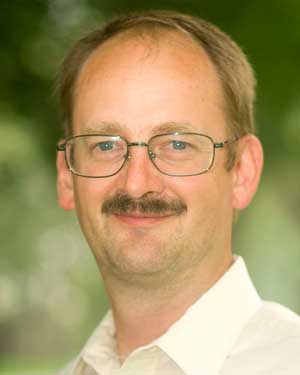
Dan Smith
Professor of Chemistry
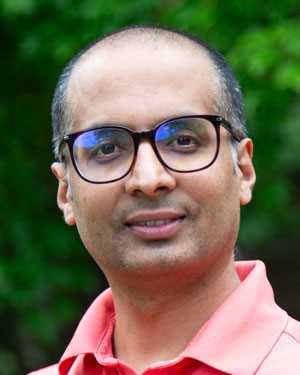
Department ChairManu Bhattarai
Assistant Professor of Physics
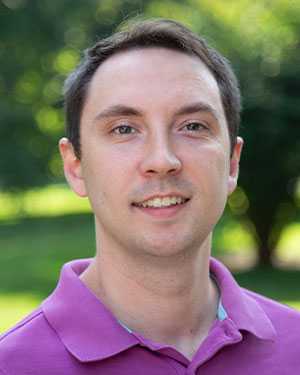
Joey Lyon
Assistant Professor of Computer Science