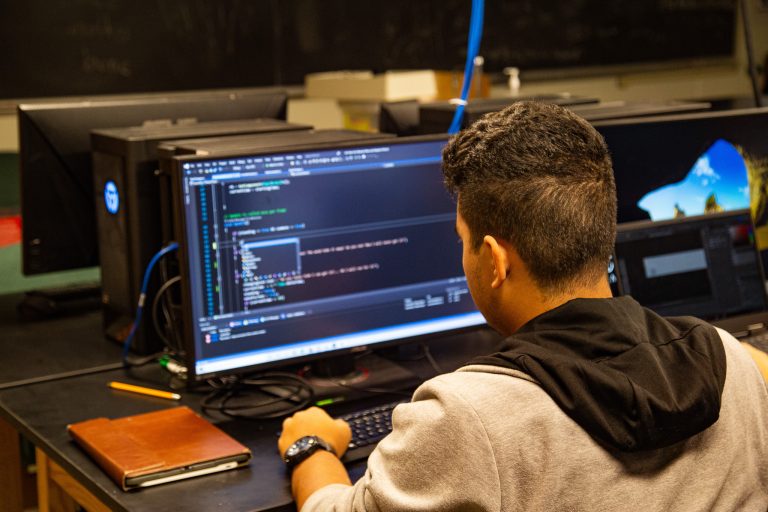
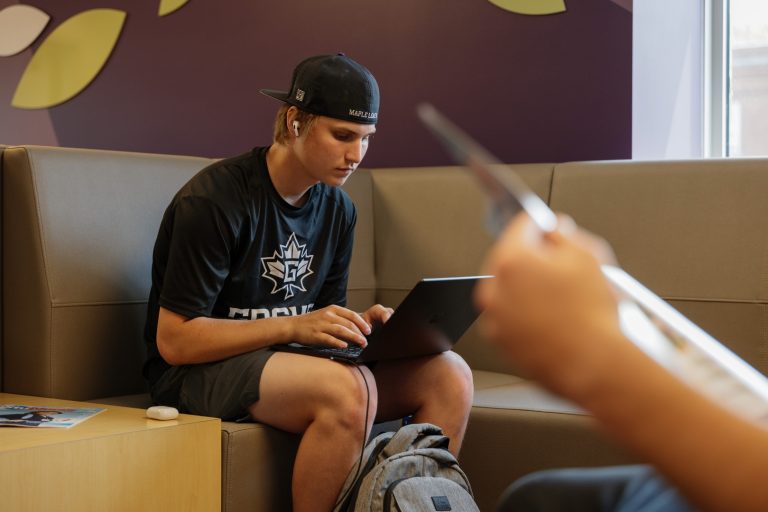
I get to learn more about the community, especially in Goshen. It shows me how important it is to know your community in app and web development.

Game Development
Minor

Enhance your major with game development
Bring the creative and technical edge of game design to what you’re already studying.
Game development is an undergraduate minor that blends programming, drawing and animation, and is open to students in any major. It pairs with majors like computer science, art and communication. You build hands-on skills by making playable, meaningful games, while you keep pursuing your major.
It’s a flexible, interdisciplinary minor with small classes and personalized support through experienced faculty from both art and computer science departments, helping you grow on both the creative and technical sides of game creation. It will also prepare you for work in game design and development, app and web development, UX/UI design, interactive storytelling and digital media production.

What you’ll explore in the minor
The game design minor at Goshen College sits where computer science meets studio art. You’ll write the code that makes a game run and create the visuals that make people want to play it.
On the programming side, you’ll first take Programming I and II, studying problem solving, object-oriented design and data structures. Intro to Game Development then puts those skills to work building 2D games in C#, with rapid prototyping, play testing and design iteration.
On the art side, Drawing and Figure Drawing will build your eye for composition, perspective and the human form, and in Motion Design, you’ll learn animation with industry-standard software like Adobe After Effects.
It all comes together in Advanced Game Development, where you work in 3D, program in C# and build in Unity alongside students from both art and computer science. By the end, you’ll have actual playable work as part of your professional portfolio. View the complete program requirements in our catalog.

Hands-on from the start
You’ll gain real-world experience by collaborating on digital projects, developing your own games, joining coding sprints, presenting in student showcases and competing on interdisciplinary creative teams. Along the way, you build fluency in industry-standard tools like Unity and Adobe After Effects, and the C# programming language. Collaborative, team-based learning is central here, just as it is in professional game development studios. The capstone class, Advanced Game Development, is designed that way on purpose: it puts art students and computer science students on the same team.

Kevin Mazariegos-Perez '22
Developer at Solution Source

Paying for Goshen College
Most Goshen students receive financial aid or scholarships, so the sticker price is rarely what you actually pay. To see your own price after aid, run the net price calculator, or explore your options at the financial aid and scholarships pages.
Common questions about game development minor
The minor is open to students in any major and is interdisciplinary by design. Its coursework comes from art, communication and computer science, so it sits naturally alongside those majors while adding a creative or technical aspect to whatever else you’re studying. Regardless of what you study, it helps you stand out in digital industries.
You’ll build games in Unity, writing your code in C#, and animate in Adobe After Effects. The studio courses keep things analog — pencil, charcoal and paper — while Programming I and II introduce the everyday tools of software development, from version control to debugging.
You’ll combine game design, programming and visual art across 23 credit hours. The required courses are Programming I, Programming II, Intro to Game Development, Advanced Game Development, Drawing, Figure Drawing and Motion Design. You’ll program in C#, build games in Unity, and animate with software like Adobe After Effects. Because the minor carries real art coursework, you won’t just learn how to make a game work, you’ll build games that are engaging and beautiful.
Yes. The minor includes two semesters of programming, starting with the fundamentals. You’ll also take Drawing early, covering the fundamentals of visual composition, before moving on to Figure Drawing which builds on your knowledge. Plenty of students come to the minor from the programming side and leave with drawing skills they didn’t expect to have; and many art students take this minor and leave with the ability to program. Either way, you’ll have small classes and personalized faculty support, so you can excel here whether you have experience in art, in coding, or in neither.
No. Drawing is designed as a first course — it covers the fundamentals of drawing and visual composition, from line, value and perspective to more expressive work across a variety of media. You take it before Figure Drawing, which builds on it with a focus on the human body and a visual understanding of anatomy. Plenty of students come to the minor from the programming side and leave with drawing skills they didn’t expect to have. The reverse is also true: art students come in and leave able to program.
Starting in your first or second year gives you the most room, but the minor is still very doable later. The trick is that six out of the seven courses in this minor need to follow a certain order:
- Programming I → Programming II.
- Intro to Game Development → Advanced Game Development.
- Drawing → Figure Drawing.
- You can take Motion Design anytime.
Earlier is easier, because at least two of your semesters will have a fixed order. If you’re interested, talk with a faculty advisor about when the courses run so you can map the sequence around your major!