


Fetal Pig Dissection Guide
Why fetal pigs are good dissection specimens
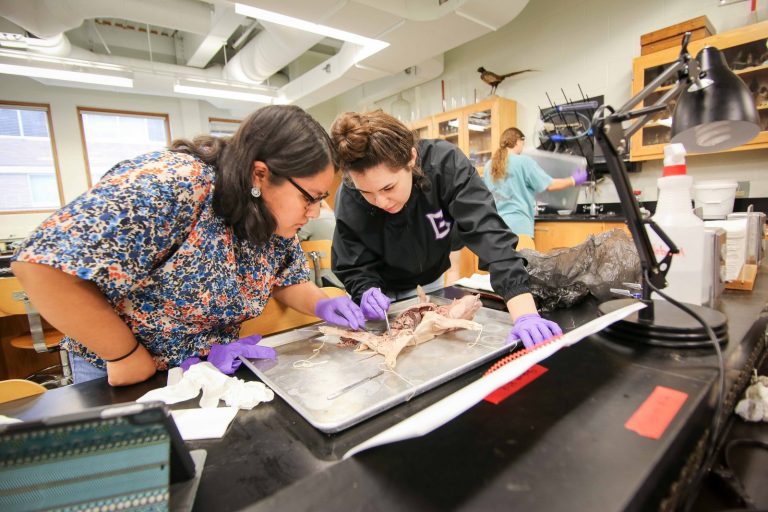
- The fetal pig is a mammal, like humans. Nearly all major structures are the same or similar in anatomy. While there are some interesting differences between pigs and humans (see some comments under the ‘hints and tips’ page), the most important things are very similar.
- Fetal pigs are not bred for the purpose of dissection. They are a by-product of the pork food industry. (1)
- Fetal pigs are not killed for the purpose of dissection. Those that are not used for education will be used for fertilizer production or discarded. (1)
- Most people do not think of pigs as ‘pets’.
- Fetal pigs are relatively inexpensive. Even in the extra large size, where structures are well developed, they can be obtained for about 1/3 the cost of a similarly sized cat.
Educational advantages of dissection
- Dissection is a hands-on, investigatory kind of activity for students. Historically, dissection has been the principle tool of investigation for anatomists (2). Dissection allows students to “test the thruthfulness” of what they see in books. (3)
- Dissection engages students in “observational and kinesthetic learning that instills a recognition an appreciation for the three dimensional structure of the animal body, the interconnections between organs and organ systems, and the uniqueness of biological material.” (2)
- Dissection impresses on students the normal variation that is present in the natural world. No two fetal pigs, even though they are perfectly normal, will look exactly the same. In fact, to do well on practicals, students MUST looks at several examples of each structure in different animals. Occasionally, quite significant anatomical variations (anomalies) will be noticed. Most would function perfectly normally. This helps to develop “students’ powers of observation.” (3)
1) “Everything you wanted to know about fetal pigs but didn’t know
who to ask”, Nebraska Scientific brochure, 3823 Leavenworth Street,
Omaha, Nebraska 68105-1180, phone 800-228-7117.
(2) “Human Anatomy & Physiology Society Position Statement on
Animal Use”, HAPS News, November 1995, page 12.
(3) “Dissection”, by John Richard Schrock, The Kansas School
Naturalist, Vol. 36, no. 3, Feb. 1990. Emporia State University, Emporia
Kansas.
Fetal Pig Dissection Guide
113 pages, 63 illustrations, 33 medical notes. Coil bound.
Last updated Sept., 2004
Learn more about the Biology major at Goshen College.