

Tuition, room and board and $300 travel fee.
Sequential SST
U.S. Disaster Site
Theme: Ecological Justice
What to expect:
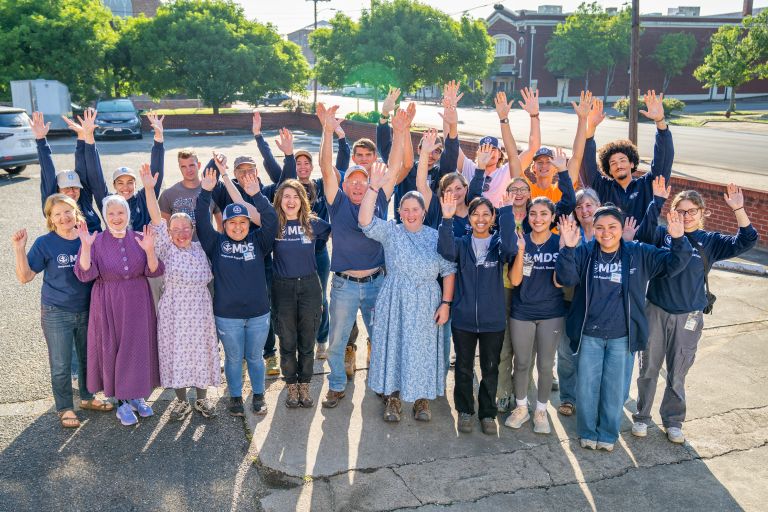
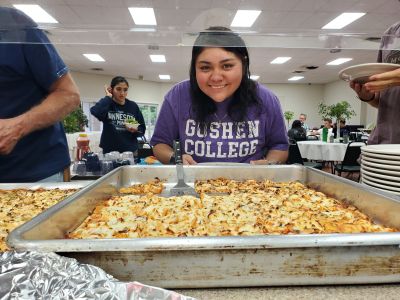
You will spend two weeks volunteering on a recent disaster site with Mennonite Disaster Service. You will live in communal housing and share communal meals. The last four days of the course will be spent at a retreat working on final projects. You do not need construction skills to participate, but you do need to be physically able to do repair and clean-up work for 8 hours per day.
The disaster site could be anywhere in the U.S. The upcoming destination is announced in early February. Previous class locations included Mariana, Florida, Red Lake, Minnesota, and Selma, Alabama. The re-building has been in response to tornadoes, hurricanes, floods, fire.
Upcoming Terms & Trip Leaders
- May Term 2025-26 – April 29 to May 20, 2025
- Mike McHugh and Dale Klassen
- Offered every other year.
Destination Course Specifics
This immersive course focuses on the direct environmental disaster impacts on a local community, with an emphasis on social inequalities and the resources, relief, and response available to communities post-disaster. It builds upon social policy, climate change research and disaster management scholarship. Community service and action-research opportunities and expectations are built into the course.
Additional Courses to Complete SST theme
- GLST 241: Foundations, Environmental Sociology OR Ethnography
- GLST 251: Resilience and Renaissance (Detroit) OR Ecology and Sustainability in the Indian Himalaya
- GLST 300: Global Issues, Ecological Justice
All sequential SST courses are 3 credit hours. GLST 241 and 300 are on campus.
 Global Education
Building Homes and Building Hope
by Mike McHugh “Recovery goes beyond building houses–it helps people regain lost hope and helps them preserve their history, community, and relationships” Shalom Solomon Teferi We wrapped up our time in Lahaina last weekend after working hard for two weeks…
 Global Education
Keeping Lahaina Lands in Lahaina Hands
by Mike McHugh We’re halfway through our second week and are seeing a lot of progress from when we started last week. The roof decking is nearly complete on the Madrigal house and most of the exterior sheathing is installed.…
 Global Education
Wrapping up Week 1 in Lahaina
by Mike McHugh We wrapped up our first week of working with MDS in Lahaina on Thursday and made a lot of notable progress on several homes in just four short days! The students learned a lot of new construction…
 Global Education
MDS Work in Lahaina Begins
by Mike McHugh Sunday evening our group arrived in Lahaina by caravan–we were grateful for the Mennonite Disaster Service (MDS) leadership team who picked up all 17 us of and our luggage in three vehicles! For the next two weeks,…
 Global Education
Goshen College Arrives on Maui
by Mike McHugh We arrived at Camp Pi’iholo at about 10PM on Wednesday night exhausted from our bus ride, multiple plane rides (complete with a short layover where we literally exited our plane and shuffled into the boarding line for…
 Global Education
…and we’re off!
by Mike McHugh Here’s to hoping that we do not endure as many travel mishaps on our journey to Lahaina as Steve Martin and John Candy experienced in Planes, Trains, and Automobiles! As I write this we are settled into our large bus…
 Global Education
Lahaina Weekly Reports by MDS
by Mike McHugh Next week we depart for Lahaina to join the many hands that have spent the last few years helping build homes for families impacted by the 2023 wildfires. Today, I want to share with you another great…
 Global Education
MDS 2026 – Lahaina, Hawai’i
by Mike McHugh Welcome to this year’s SST blog for the Environmental Disaster and Response with Mennonite Disaster Service (MDS) May term course. This year we will be traveling to Lahaina, Hawai’i to work with MDS to build homes that…
 Global Education
What I’m bringing back
By Aysia Adkins As we come back and re-enter our lives which we left on May 1st, I’m filled with many impactful memories that have accumulated in just 20 days. It sort of doesn’t feel right to jump back into…
 Global Education
Becoming like family, carrying our voices forward
By Lexie Coburn On May 20 we got home from our closing retreat at Camp Nacome in Tennessee where we reflected and processed our shared experiences and individual experiences we had in Selma, Alabama. Who would have thought 13 people…
 Global Education
Getting comfortable with the uncomfortable
By Jazmin Ibarra Today is May 19th, I am sitting in a community lodge in Camp NaCoMe in Tennessee for our SST closing retreat, reflecting on my experiences and my encounters in Selma. Where can I even start? Before this…
 Global Education
“And so I am embedded within the soul of their community”
By Jacob Dixon My experience working with a crew of people that exert their best effort to make sure that other people are being cared for, has been one of the most fulfilling things that I have done all year.…
 Global Education
Fulfillment and Faith
By Lily Herrera The one word I want to use to describe today and for the past few days is fulfilling. This morning, May 15, I gave a devotion in front of the Mennonite Disaster Service year long volunteers and…
 Global Education
Interconnected Struggle, Persistent Work, Enduring Hope
By Judith Rangel Visit to the Legacy Museum On Saturday, May 10th, we visited The Legacy Museum in Montgomery. It was a meaningful and unforgettable day that will stay with me forever. While Mexicans/Latino stories were not discussed often, I…
 Global Education
Grappling with a difficult legacy
By Summer Cuatepotzo Perez Impactful. Speechless. Astounded. Disgust. Anger. Confusion. Sadness. None of these can describe how emotionally overwhelmed I personally felt, my physical response- tears. You ask… where in the world did you experience this? Or what happened that…
 Global Education
Reflections at the end of week 1 with MDS
By Parker Sullivan Today, May 9, was another productive work day and the end of our first work week with MDS. Each of our three groups were working at the same separate sites as the rest of the week....
 Global Education
Stories of Hope in Selma
By Evelyn Perez As I sit here today reflecting on my experience so far in Selma, I want to share that I’ve explored and learned many life-changing stories. Every place we have visited holds very rich and valuable voices. If...
 Global Education
First MDS Work Day!
By Jaden Harris Today marked our first day of service during our trip. My group – which consisted of Hillary, Lily, Jazmin, 2 other MDS leaders, and myself – were tasked with helping the Tolbert family with repairs to their…
 Global Education
First Weekend in Selma
By Carlie Lavon Webber Travel to Selma After loading the bus and traveling for a little over 2 days our Goshen College group reached Selma, Alabama. On our travels, we stopped in Mammoth Cave, Kentucky! Our group enjoyed a delicious...