

By Hillary Harder On Sunday, July 26, our students returned to Quito from their service communities and we began our final retreat together! The afternoon was full of joyful reunions as each student arrived at our Quito home, la Casa…
News
Reflections on visiting the Guacamolón
May 08 2026
By Ana Alves Machado
Last week, we visited the Palacio Nacional de la Cultura or as Guatemalans nicknamed it “El Guacamolón” (The Big Avocado), because of its distinctive green color. It is located in Guatemala City’s historic center. Today it serves as the headquarters for the President of Guatemala and is open to the public for guided tours.
The palace was built from 1932 to 1943, during the government of General Jorge Ubico. We can see his mark everywhere in the building, from his thumbprint on the handle of every door; to the color green, which was his favorite; and in the number five appearing everywhere–from the windows to the pillars. Outside of Ubico’s obsession with the number five, the palace contains a lot of beautiful stained glass that romanticizes the relationship between indigenous people and the Spanish colonizers. Those stained glass works tell a false story, where Guatemala was built by a harmony of Europeans and indigenous peoples, leading to the Guatemala of today.
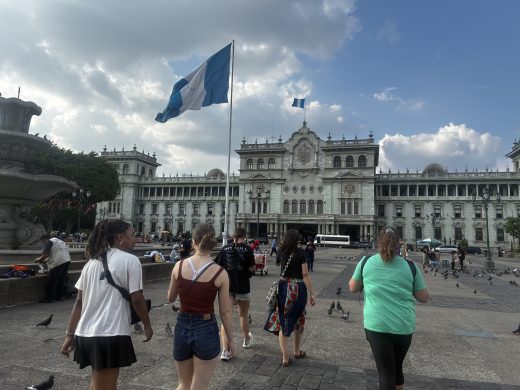
Walking towards the National Palace. Photo by Ana Alves Machado.
Our short visit to the palace made me think a lot about what leads to a dictatorial government. When Ubico ruled as a dictator from 1931 to 1944, he allowed forced labor for indigenous people and armed defense of private property, leading to severe repression of workers. In response, Guatemalans led a revolution that deposed the military dictatorship, leading to a period called the “10 Years of Spring.”
In 1954, however, a coup supported by the U.S. overthrew President Jacobo Arbenz. Arbenz’s agrarian reforms had expropriated unused land from the U.S.-owned United Fruit Company. He was summarily labeled a Communist, triggering CIA-backed military action to protect corporate interests and prevent Soviet influence in the region. Following this, Guatemala suffered a series of military dictatorships and a bloody civil war. During this time, military governments engaged in widespread human rights violations against civilians, eventually leading to genocide of the indigenous population.
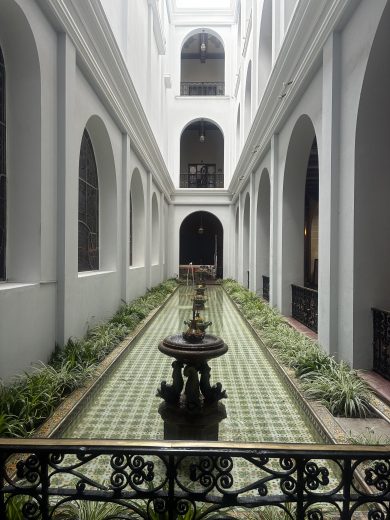
Photo by Ana Alves Machado.
Many other Latin American countries have also suffered from dictatorial governments, including the one that I grew up in. Brazil also had two different eras for its dictatorial governments. The first one was under Getulio Vargas, who first ruled as a dictator from 1930 to 1945 and then was reelected in 1951. His government was characterized by nationalism and centralized power. He also extended industrialization and created labor rights laws which earned him the nickname “the father of the poor,” although this widely-used nickname was highly influenced by Vargas’s DIP (Department of Media and Propaganda). The DIP heavily censored news, radio, and artists. Vargas’s government also suppressed protests and persecuted intellectuals like professors and university students, or anyone opposed to the government.
The next period in Brazil, from 1945-1964, as in Guatemala, was a period in between oppressive governments. It was marked by advances but also economic instability, which led to another coup in 1964 and a period of more than two decades of authoritarian regime highly supported by the U.S. Those governments were also characterized by deaths, disappearances, torture, and censorship. Some families still don’t know what happened to their loved ones during these years. Recent Oscar-nominated Brazilian movies tell some of those stories, like Secret Agent and I’m Still Here.
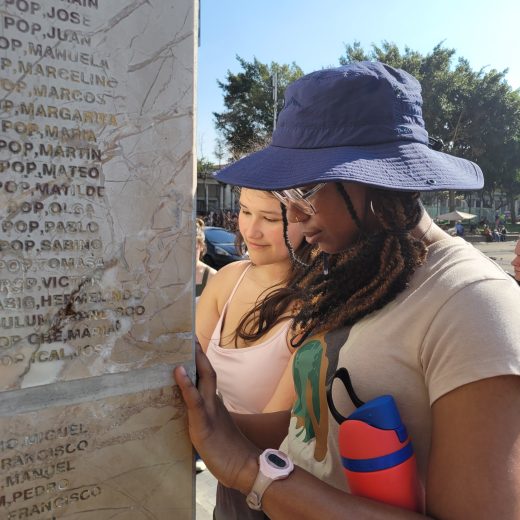
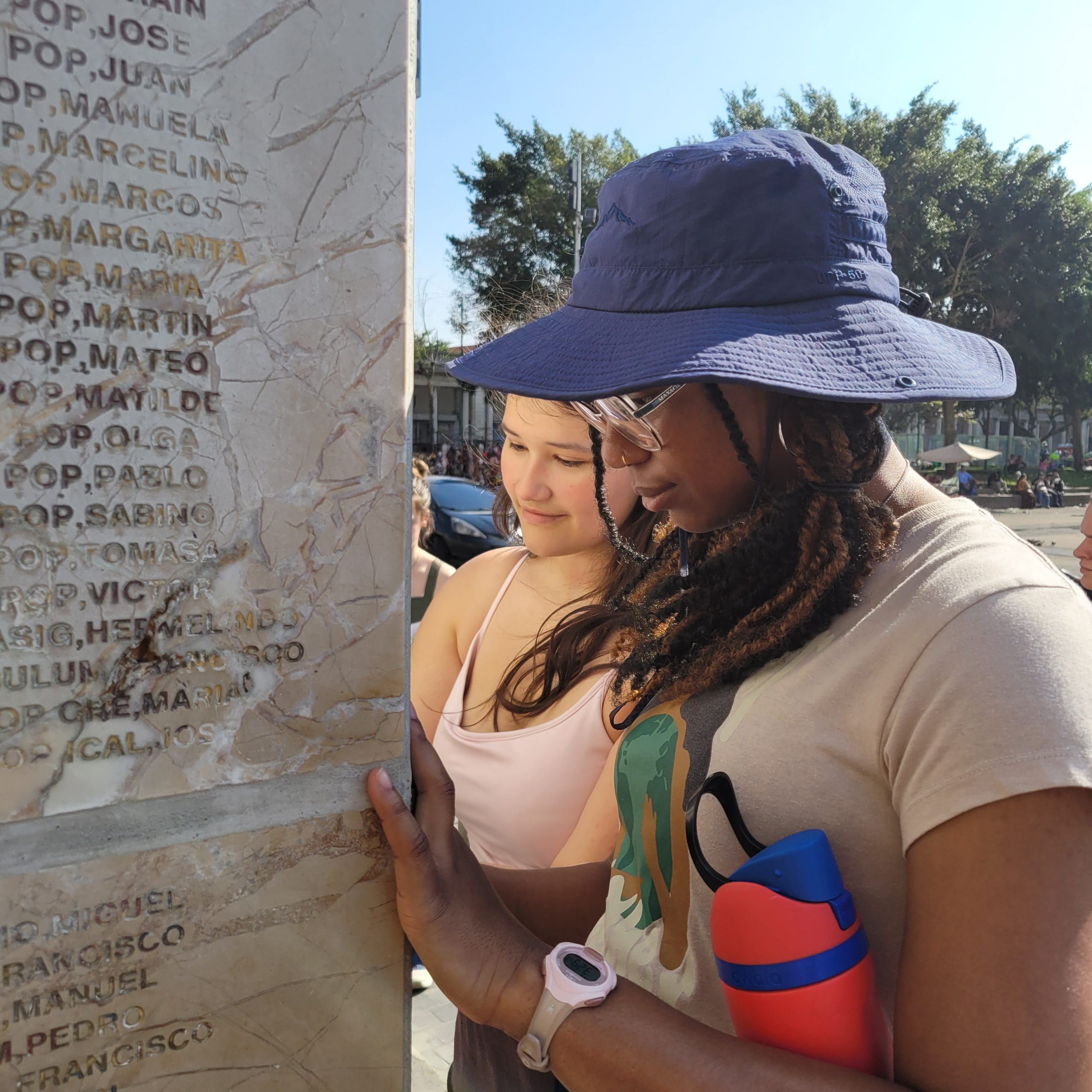
At the Guatemalan Metropolitan Cathedral, across the plaza from the National Palace, students created rubbings of the names of Guatemalans disappeared during the civil war. Photo by Elizabeth Miller.
During our visit to the palace, we saw a temporary exhibit on the life of Monseñor Juan José Gerardi. Here in Guatemala, Girardi helped document atrocities from the civil war, so that families could know what happened to their loved ones that had been killed or disappeared. Although the peace accords were signed in 1996, following 36 years of civil war, much of the truth about the details of the armed conflict remained hidden from the public in the years immediately after the accords.
In his role as bishop of the Catholic Church, Girardi acted as a defender of human rights and the primary architect of the REEMHI (Recovery of Historical Memory) project that documented human rights atrocities during the Guatemalan civil war. For that same reason, he was assassinated by members of the Guatemalan armed forces in 1998, only two days after the public presentation of the initial REEMHI report. The report was later published as Guatemala: Nunca Más; its title represents a commitment to preventing a recurrence of violence, forced disappearances, and torture.
Although those stories happened more than 20 years ago, the memories are still alive. Just as in Brazil and Guatemala, it’s important to know the history of our countries, so it does not happen again. We need to know what happens in our governments, when leaders appear and the population idolizes them, when the media is censored and manipulated, and when the government keeps things in secret.
If we fail to maintain a critical perspective, we endanger our neighbors, our family, and ourselves.
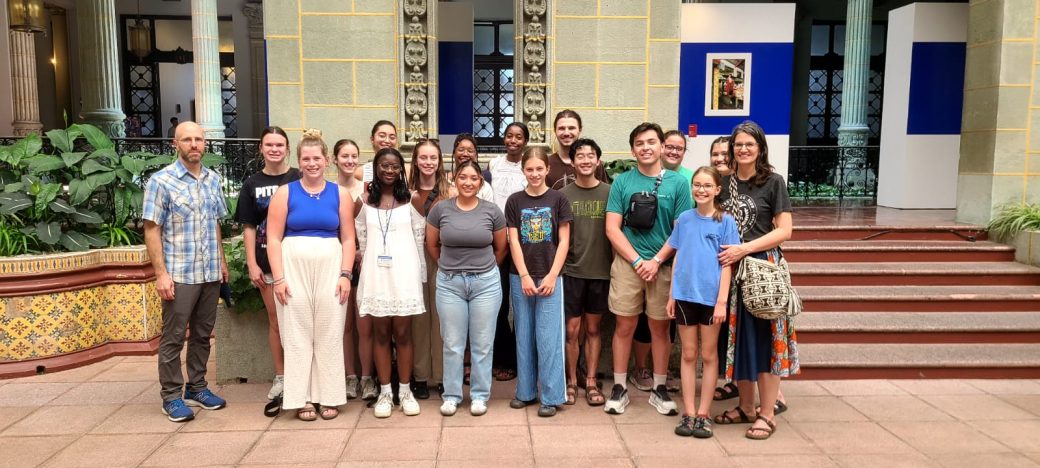
Our group at the Palacio Nacional in Guatemala City. Photo by Santos Méndez.
 Global Education
Final retreat in Ecuador
 Global Education
Life on the ward
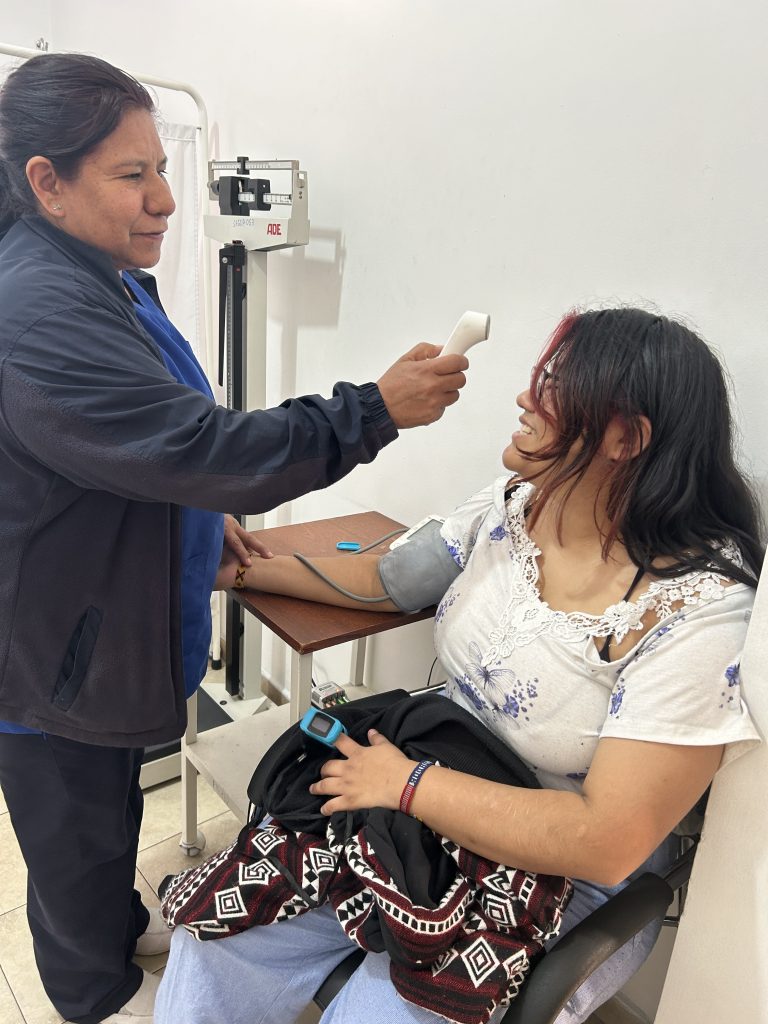
By Dayanara Aguirre-Mulato During my service placement at the municipal Centro Médico in Riobamba, I had the privilege to be able to work alongside other nurses. Day to day each patient comes in to register for their appointment and I…
 Global Education
Service visits: opportunities for connection in Ecuador’s “provincias”
By Hillary Harder During the Service term, leaders have the privilege of traveling to visit each student at the home and volunteer assignment where they are spending their time during the second half of SST. For us, that meant traveling…