

In the first convocation of the 2025-26 academic year, President Stoltzfus gives her welcome address and announces student awardees.

News
“More than a mind factory”
Jun 02 2026
This presidential column originally appeared in the Spring/Summer 2026 issue of Bulletin
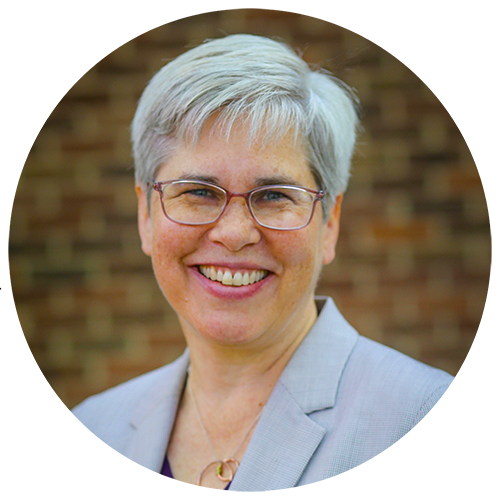 by Rebecca J. Stoltzfus ’83, president of Goshen College
Our culture is in a raging debate about higher education. Is college supposed to be an elite intellectual experience? Or focused on the practical and technical skills needed to fuel the economy? Or primarily for research and discovery?
Goshen College is strongly grounded in the idea that it is even more than any of that. As W.H. Cowley said in his defense of the liberal arts college a century ago: “We are more than a mind factory.”
A liberal arts education is liberating. The purpose of a Goshen education is to develop the capacities of our students to live a life of freedom and meaning. Goshen students have the freedom to explore ideas and disciplines, discover the world and each other, and realize their individual human powers of intellect and creativity and service.
The liberal arts approach at Goshen is further shaped by Anabaptist-Mennonite faith, which means our students experience freedom in a community that treats you with dignity, even in failure and mistakes. We learn about forgiveness and grace because we practice it. The human longing for justice, peace and freedom has never been perfectly realized. But this is what we are made for, and what God wants for us: freedom that is personal, economic, structural and spiritual.
While faculty across much of higher education have embraced “liberal neutrality,” the idea that educators should not take a position on what is right or virtuous, Goshen College has not. We believe truth is real and worth seeking, even if our understanding is imperfect, and we regard each student as a whole person, with dignity, cultural heritage and spirit.
In this age when artificial intelligence is capable of astonishing feats, we know intelligence alone cannot create the moral and civic renewal we need. Our communities are aching for discourse that creates dignity for people. As our machines
accelerate to speeds we cannot fathom, we ache for Sabbath rest and for each other, whether we know it or not.
Michael Pollan, who writes about nature and culture, recently said: “Despite how it may seem, the internet is not actually the whole of the world. But to AI, it’s all you got.”
At Goshen College, the internet is not all we’ve got. That is why we express our values in our community life as well as our curricula — compassionate peacemaking, passionate learning, servant leadership, global citizenship — all centered in the abundant love and mercy of Christ.
Goshen College is an intellectual enterprise that connects the arts, humanities, professions and sciences — and it is also a social and spiritual environment, where relationships educate and our community orients to love.
Many years ago, when I was on the Goshen College Board of Directors, a pastor remarked that Goshen is really good at forming good people. Indeed, our students and alumni are doing good in their communities! Yes, we are more than a mind factory. We form one another to serve the world.
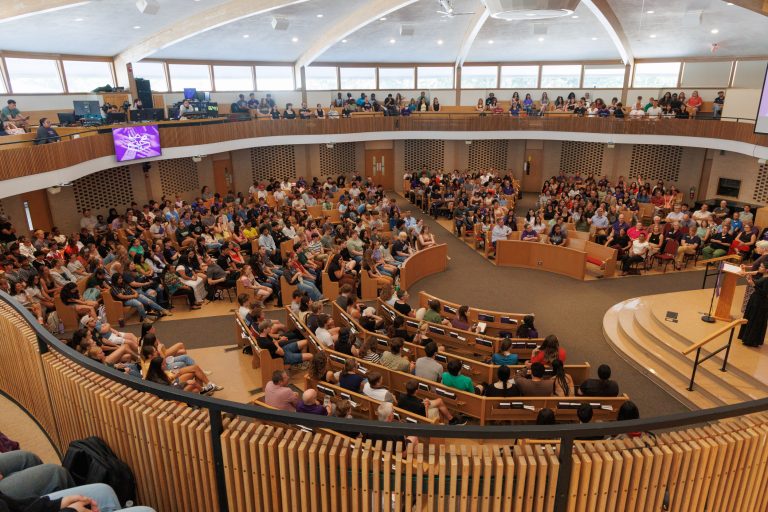
President’s Welcome Speech: ‘Truth, Together’

What more can a prof do?
No single course may better define Goshen College’s commitment to liberal arts education than Mary Oyer’s Fine Arts class, first introduced in 1945.
Till we meet again
My professional connection to Goshen College began in 1988, when Sociology Professor Emeritus J. Howard Kauffman hired me as a research assistant for his work on North American Mennonite beliefs and social patterns.