

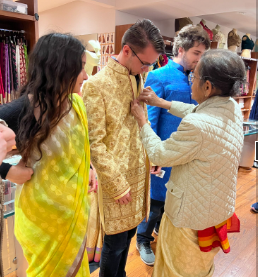
Across the Street and Around the World by Andrea Mata and Tuka Farhan We had the opportunity to visit Devon Ave., a vibrant and culturally diverse east-west street on Chicago’s North Side. With its strong cultural and religious identities,…
News
Meeting Muralist, Hector Duarte
Jun 03 2026
By Kaliah Lefever and Kenny May
Nearly every wall seemed to tell a story as we walked the streets of Pilsen with our guide, Luis Tubens. Luis introduced us to the Mexican muralist movement while guiding us past the neighborhood’s colorful murals, many of which tell stories of immigration and cultural pride.
The Mexican muralist movement was led by “Los Tres Grandes,” Diego Rivera, José Clemente Orozco, and David Alfaro Siqueiros in the early 1920s. As Luis explained, the movement aimed to make art accessible to ordinary people by bringing it out of museums that only the wealthy could afford and into public spaces where it could inspire the community. Muralists were making a statement by painting directly onto public spaces. Located on Chicago’s Lower West Side, Pilsen was originally settled by Bohemian immigrants before becoming home to many Mexican steelworkers and immigrant families, many of whom were later pushed farther west because of displacement and gentrification.
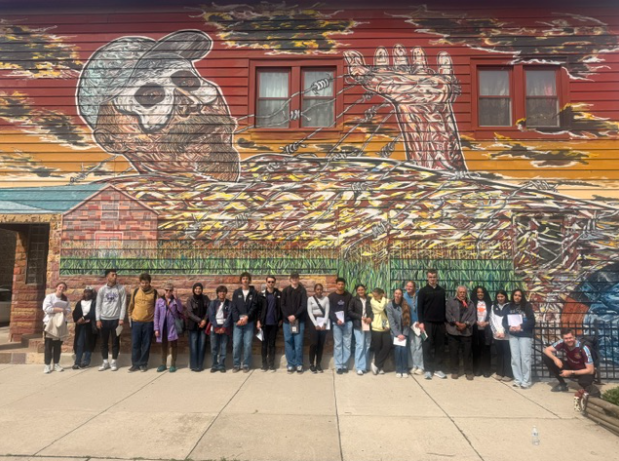
In our tour’s most memorable moment, we received a special surprise when artist Hector Duarte himself stepped outside to wait for another tour group. As we viewed “Gulliver in Wonderland,” the mural that spans the side of Duarte’s home and studio building, we were very fortunate to be able to ask questions and get answers straight from the source. This was a Chicago SST first, we were told, making the moment feel that much more special to all of us. Duarte spoke in Spanish, as our guide Luis translated, and made the joke that speaking two languages made someone worth double (while only speaking one).
Hector Duarte was born and educated in Mexico before moving to Chicago, where he became an important figure in Pilsen’s art scene. His work focuses heavily on themes of immigration, culture, and social justice, and he studied mural painting at the workshop of the aforementioned David Alfaro Siqueiros, one of the “founding fathers” of muralism. The title “Gulliver in Wonderland” is based on the novel Gulliver’s Travels by Jonathan Swift. Duarte explained to us that the inspiration stemmed from the idea of Gulliver, who is feared because he is different. A Latinx version of the character is depicted, donning a Dia de los Muertos mask, a motif to represent those who have passed. Barbed wire ties the man down, symbolizing the oppression immigrants face.
One moment that stood out to us was when Duarte explained that being Mexican-American gave him “two glasses to view the world through.” It made me [Kaliah Lefever] think of my identity as an African-American, and speaks to W.E.B. DuBois’ concept of “double consciousness,” the internal psychological conflict caused by carrying both identities of American and Black. Duarte also made it a point to let us know that he does his work not solely for a Mexican audience, but for all immigrants who have lost their homes and their languages—or who still battle to retain them.
Photo captions:
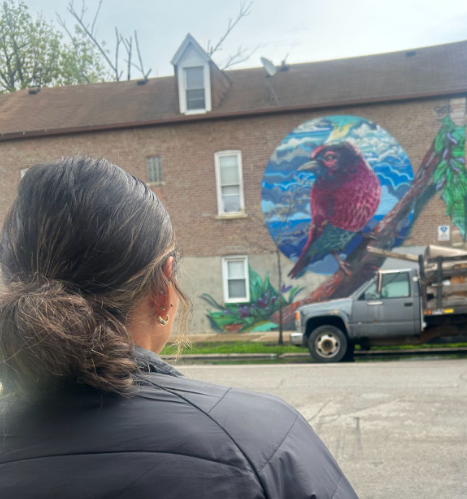
- Mural of a bird, a significant and symbolic figure that “transcends dimensions.”
- Our Chicago to Amish Country class standing with Hector Duarte (far right) in front of his mural “Gulliver in Wonderland.” This shows the struggle of immigrating to the US from Mexico.
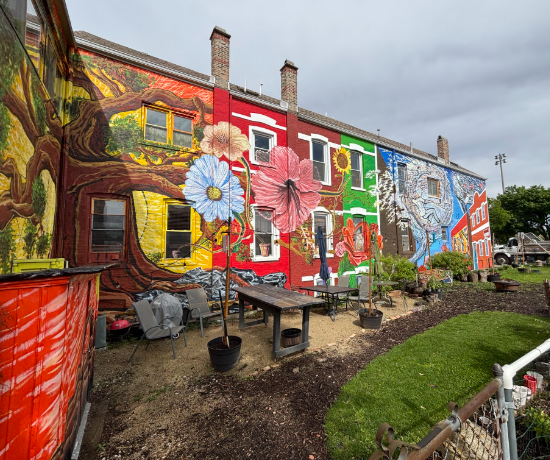
- “Fight to Stay” – Painted by Hector Duarte and Gabrielle Villa in 2022, depicting how Mexicans have to fight to stay in their area/America.
 Global Education
Chicago’s Devon Avenue
 Global Education
Paseo Boricua: Small Community in a Big City
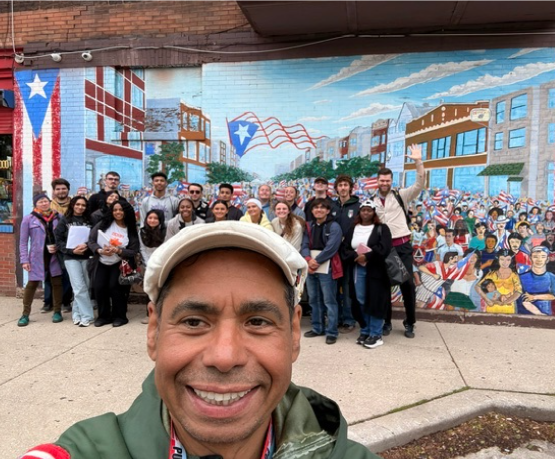
By: Camryn Barrows, Brinleigh Arredondo, Deecon Hill Entering Paseo Boricua A quick flash to the 70s: gentrification was a fast-acting force that rapidly pushed Latino and Puerto Rican populations away from Lincoln Park, which is now the poster child of…
 Global Education
Amidst The Amish Among Us
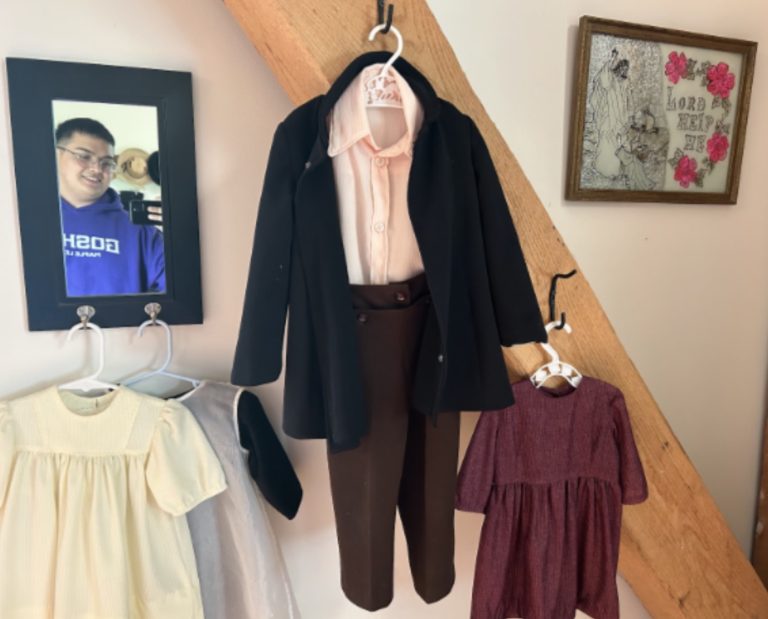
Our day began as any good Amish morning, at the Rise‘n Roll Bakery which is – disappointingly – not owned by the Amish founders anymore. Curious folks entered the store and scoured through the endless aisles of Amish goods in...