

This presidential column originally appeared in the Spring/Summer 2026 issue of Bulletin
News
Elkhart Branch: Strategic action in a time of uncertainty
Jun 10 2020
By Joe Springer ’80, Curator, Mennonite Historical Library
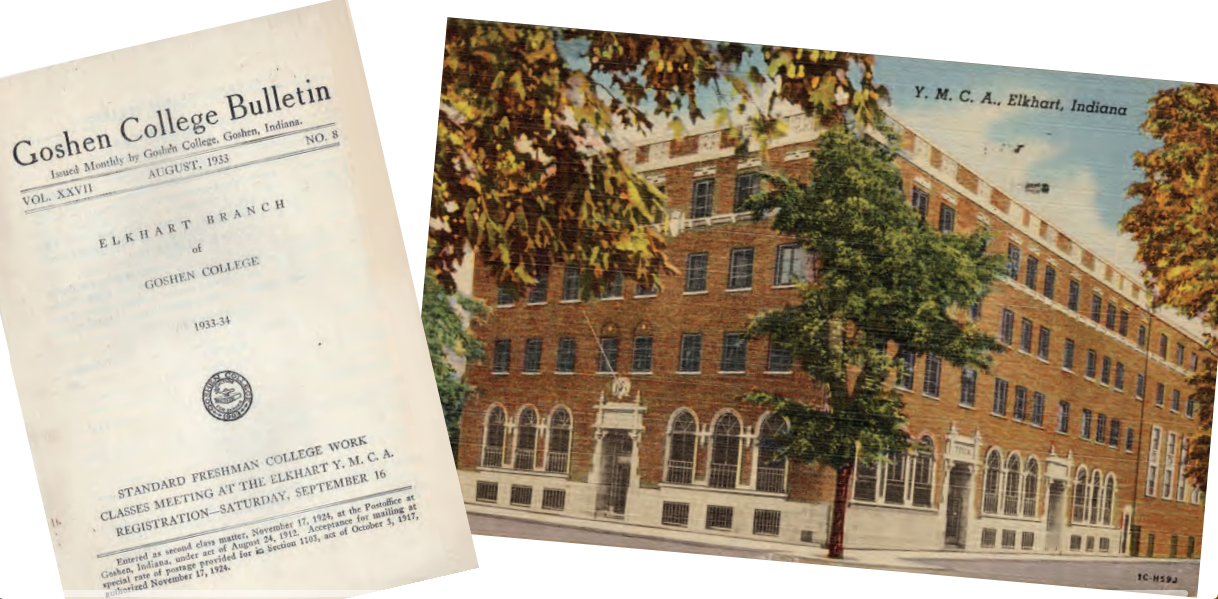
As the 1933-34 academic year opened in the midst of the Great Depression, GC President S.C. Yoder wrote, “We are facing a barren sector in the world’s history, … a time when the multitudes see nothing fruitful in the years ahead.”
But Goshen chose that fall to launch an Elkhart Branch. For the several years prior, GC faculty and students had participated fully in the global swirl of economic upheaval. Half of the previous year’s faculty salaries languished in a pool of notes for unpaid student tuition. With student enrollment then as now a key to financial stability, GC sought to increase enrollment.
Prospective students often could not afford even a short move from home. So GC brought a full first-year course to Elkhart. Discounting a semester’s tuition from $75 to $50, the college required full payment in advance. Elkhart’s YMCA contributed classroom space in its commodious new building on Third and Franklin Streets.
GC profs carpooled each morning to teach one of five courses. A dozen Elkhart students traveled to campus once a week for a chemistry lab. Professor Edward Yoder made good use of the time he spent waiting for colleague Samuel A. Yoder ’28: an hour of prep daily before class, after class swimming in the YMCA pool twice a week and reading at the public library on the remaining day.
Elkhart Branch first-year males played GC first-years in basketball. GC did achieve a slight enrollment increase that year — mostly accounted for by the Elkhart Branch. Faculty then planned to expand to a two-year program. However, enrollment in Fall 1934 for Elkhart was too small to warrant continued operation. The few who planned to enroll commuted to Goshen instead.
“More than a mind factory”
What more can a prof do?
No single course may better define Goshen College’s commitment to liberal arts education than Mary Oyer’s Fine Arts class, first introduced in 1945.
Till we meet again
My professional connection to Goshen College began in 1988, when Sociology Professor Emeritus J. Howard Kauffman hired me as a research assistant for his work on North American Mennonite beliefs and social patterns.