

This presidential column originally appeared in the Spring/Summer 2026 issue of Bulletin
News
President’s Welcome Speech: ‘Truth, Together’
Sep 04 2026
President Rebecca Stoltzfus gave this welcome address on Sept. 2, 2026, in the first convocation of the 2026-27 academic year.
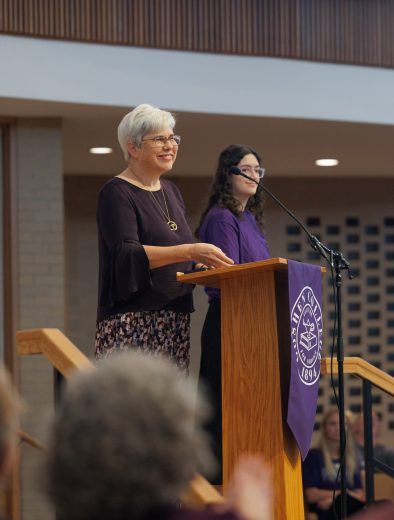
President Rebecca Stoltzfus, opening convocation 2026
Hello, Goshen College! Welcome to Fall 2026! It is fantastic to be here with you.
Opening convocation is a welcome, a welcome back, a celebration of a new year and a reminder of who we are and what we value.
As we gather for this new year of teaching, learning and discovery, my theme this morning is truth.
Our commitment to Truth is depicted in the center of our college seal as a lamp and a book:
The light of learning and the written word. The light shines in the darkness. The light of truth.
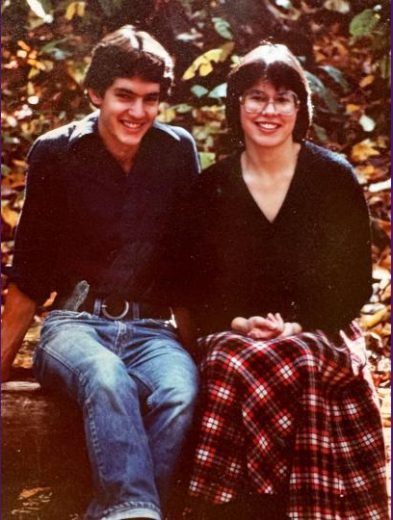
Kevin Miller and Becky Stoltzfus, 1982
We are living through a time when truth is being contested — not only what is true, but whether truth exists.
The essence of my message to you this morning is that truth is real, and it is worth seeking—but our understanding is always incomplete, and therefore we need to seek truth, together.
I like to tell stories about a GC alum in opening convocation. This year, I’m going to tell you a story about myself.
I graduated from Goshen in 1983, and married my college boyfriend, Kevin Miller.
At GC, I majored in chemistry, and Kevin double majored in biology and nursing. We then moved east to pursue graduate studies – Kevin in public health, and I in global maternal and child nutrition.
Then and now, a lack of vitamin A in people’s diets compromises their vision and their immune function, leading to excess deaths from common infections.
Young children in low-income countries are most vulnerable to Vitamin A deficiency and its consequences. But vitamin A, given in large doses, can be toxic to really little babies.
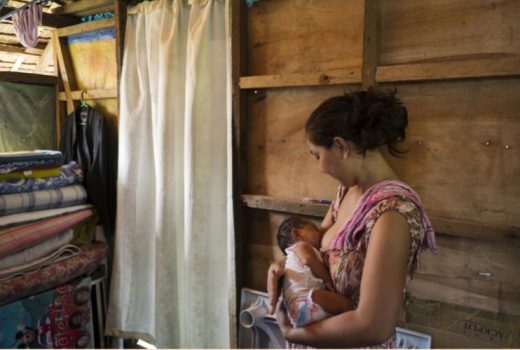
WHO/ Francisco Guerrero
The question that I wanted to address in my research was whether it would work to give a big dose of vitamin A to a mother who had just given birth and let her pass the vitamin A on to the baby naturally through her breastmilk.
I was fortunate to win a grant to support this research, and to be married to an excellent GC nurse who moved to Indonesia with me to support the clinical aspects of the research project.
This is us with our research team in the village of Prembun, in Central Java, where we carried out the research.
My career in global nutrition research spanned more than 30 years, and this single research study yielded the most clear result, with the greatest policy consequences, of any research that I have conducted.
The experiment worked: the mothers who received the high dose supplement within a week after giving birth provided vitamin A-enriched breastmilk to their babies in safe, daily, meaningful quantities.
This led to the policy adoption of this practice in the nation of Indonesia, and a global recommendation to do so by the World Health Organization.
The scientific method is a beautiful and powerful tool to understand what is true and how the world works. But the reason I’m telling you this story is not to teach you about vitamin A and human milk.
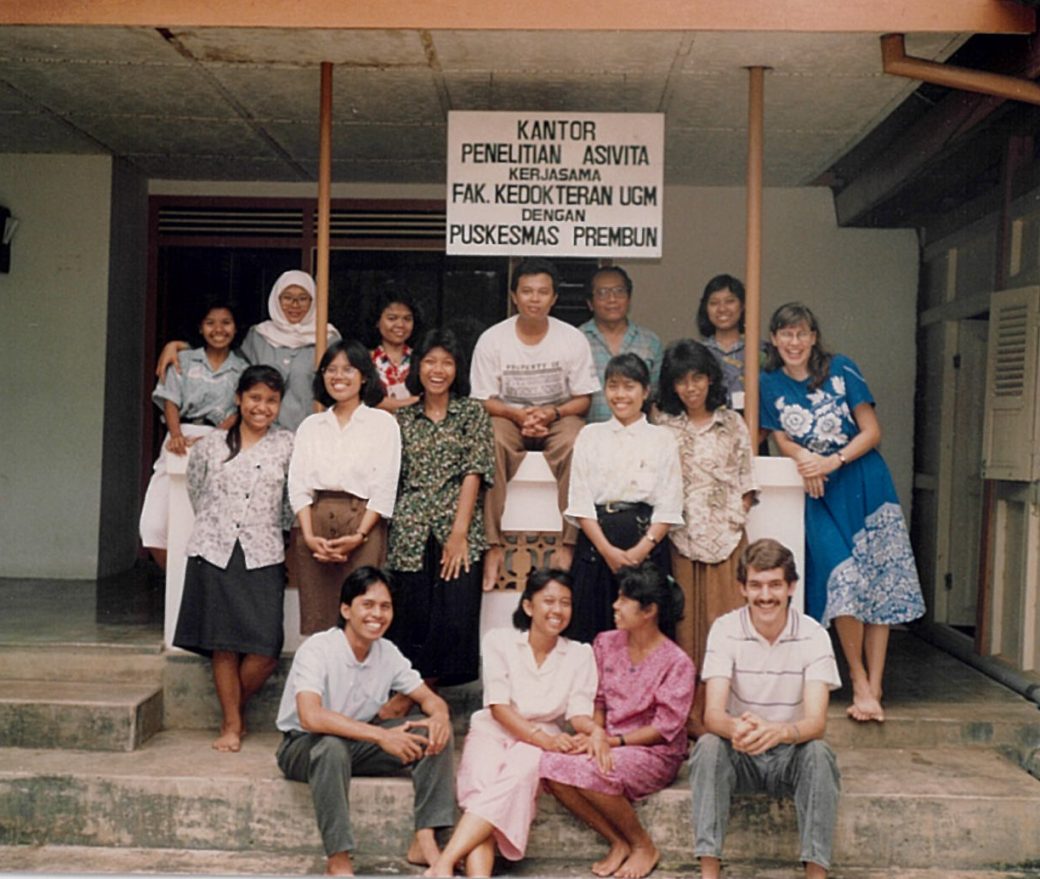
President Rebecca Stoltzfus, Kevin Miller (right) and the research team in Indonesia.
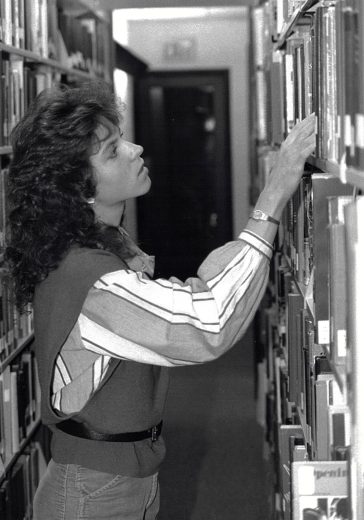
This whole story started in the library. It began with a rigorous review of the literature, working deep in the stacks of the library that held dairy science journals.
Now, I want to pause on that for just a minute, because I wonder whether all of you know what I mean when I refer to the stacks.
I’m talking about a paper-based world in which students like me had to physically go to the correct floor of the library during its open hours and find the right journal in a dimly lit corridor.
And yet, just writing about the process brings back a lot of good memories. Libraries are super cool.
And you can meet friends in the stacks!
These are the actual Good Library stacks in my era. And no, that’s not me. But I do admire her hair!
Today, our work is different. Chances are, you do not have to find that journal in those stacks. You can do your research from anywhere you have your phone or tablet or laptop, at any time of day, sitting in a comfy chair.
But in many ways, our work today is much harder. We are swimming in information, everywhere, all the time. And not all of it is true.
The very hard work that you and I now need to do is to discern what information actually matters. What sources can you trust? And how can you use them in ways that help other people trust you? I mean your classmates, your professors, and the users of your scholarship. Your clients, or audiences, or readers. The policy-makers that you want to influence.
The question has become: How do we turn an over-abundance of information into real value? How do we discern the truth, together?
As you figure this out – as we together figure this out – your human value will become more and more visible in the world.
One important way to discern the truth is by reading the work of others who precede you. I learned that it had long been known by dairy farmers that giving vitamin A to a cow would enrich her milk.
It was a simple scientific step to imagine that the same might be true for human mothers. But nobody had proved that. And anything that the medical or public health community is going to do involving mothers must be rigorously tested.
- Is it true in the context and biology of human mothers and babies?
- What research design will be required for other scientists to believe the evidence?
- How would I build a strong research collaboration in a suitable social context?
- Would it be ethical?
- Would mothers be willing to swallow a big vitamin A capsule, and let us sample their breastmilk?
And so, I was thrust directly into the much more complicated and messy human work of building collaboration and trust across borders and languages, to generate credible evidence and turn that into policy and action.
Information that exists in the library, or now on your phone or computer, is a big leap from health systems taking action. Creating productive policy discussions with health leaders and practitioners from around the world requires more than a scientific mind. It requires relationships, humility, respect and a ton of patience.
This is why a GC education sits on a foundation of core values. Our values answer the question: What kind of people must we become in order to pursue truth well?
Our core values are not designed to constrain you; on the contrary, our values form us to become people who can seek truth well and use truth wisely.
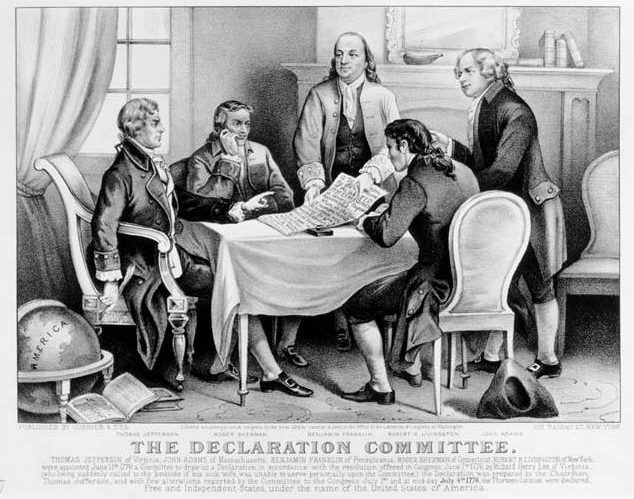
I’m going to pause my own story and come at “truth, together” from another angle. As we gather in 2026, we are also honoring the 250th anniversary of the founding of the United States of America. I was born in this country, and the more I have traveled around the world and returned to it, the more deeply I feel attached to this nation – and the more complicated my understanding of it becomes.
The anniversary celebrated in the U.S. on July 4 is of the signing of the Declaration of Independence in 1776. A drafting committee of five British colonialist men, with Thomas Jefferson as the lead writer, wrote the declaration. They were filled with bold and creative new ideas, and, like all of us, they were imperfect human beings.
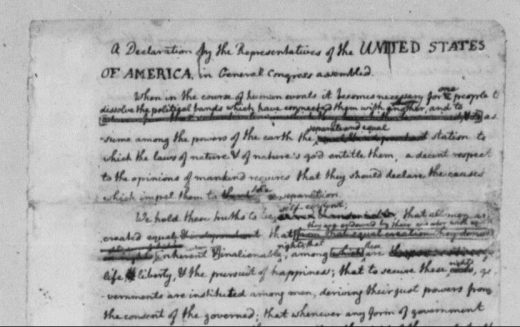 And, We all know how challenging it is to do a group writing project. They labored particularly over this most influential sentence:
“We hold these truths to be self-evident, that all men are created equal, that they are endowed by their Creator with certain unalienable Rights, that among these are Life, Liberty and the pursuit of Happiness.”
They called these truths self-evident, meaning that they were foundational principles that serve as a basis for further reasoning. They also understood these rights as endowed by the creator and therefore not subject to the authority of government. This is what unalienable means. They cannot be taken away. Human rights pre-exist the government. In fact, the rights of the citizens become the measure by which the government is to be judged. Among these rights is the pursuit of happiness.
Ken Burns, America’s best-known historian, explains: “The pursuit of happiness is not the pursuit of objects in a marketplace of things but life-long learning in a marketplace of ideas. We are meant to improve each other, to increase in virtue.”
And that has been so. For the past 250 years, people have repeatedly pointed out that these rights have not yet been realized for all.
People who include: Frederick Douglass, Abraham Lincoln and others who worked for the abolition of slavery. Susan B Anthony, Elizabeth Cady Stanton and the suffragettes who worked to extend these rights to women. Septima Clark, Dr. Martin Luther King, Jr., and many others who labored and are still laboring to extend these rights to Black and Brown people.
Today, these truths are being used by people who are advocating for the Creator-endowed rights of immigrants and refugees in a time of intense nationalism. Because of these truths, I join my voice to oppose current policies designed to make life harder for immigrants and refugees, actions that would deny them liberty and the pursuit of happiness. To those of you who are not US citizens, or whose family members are not U.S. citizens, I want you to know how much we value you at GC. How much you matter to us. We are glad you are here, and we will stick up for you within the full rights of the law.
Many people, including us at Goshen College, continue to use these truths as a means to hold the United States accountable to its own aspirations. They are true to our Biblical faith tradition and many other faith traditions.
These truths, held to be self-evident 250 years ago, have been more enduring than the flawed society that declared them. They have made further progress toward truth possible.
We need one another – ALL of us – to seek and understand the truth.
Difference and disagreement are not threats to our community or to the pursuit of truth. The threat is separation.
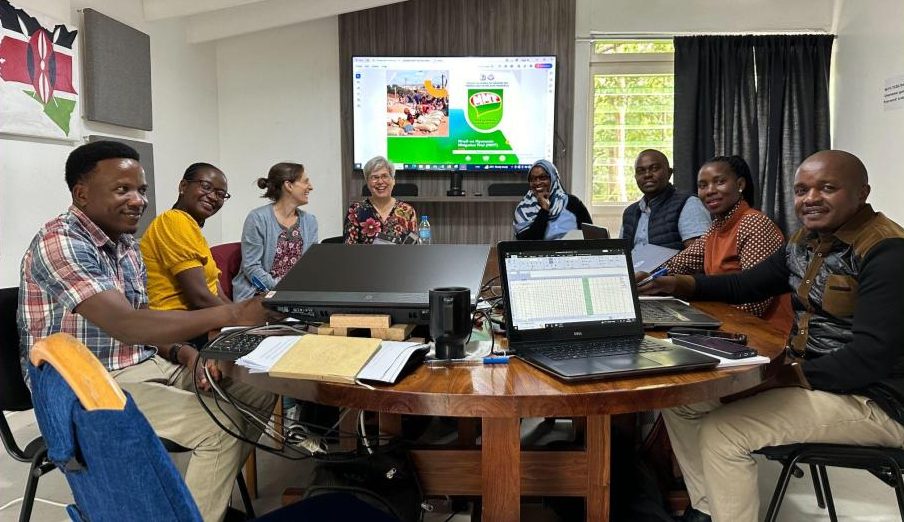
Back to my own story. In 2017, the year that I moved to Goshen to begin as president here, I launched another health research project, this time in Tanzania. I was leading an outstanding team of researchers from Tanzania, Germany, Zimbabwe, Kenya and the U.S. Our goal was to test whether a baby food product that was free from a prevalent toxin in the African food supply would help Tanzanian babies avoid growth stunting, which is a prevalent condition in many low-income families. The project was truly ambitious, and our team, based in Tanzania, did outstanding work.
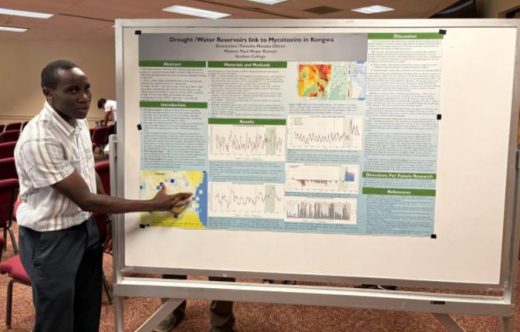
Student Timothy Okiror presenting Maple Scholars research on campus, 2026.
This time however, our carefully formed hypothesis did not prove true, due to the complexity of the food system and changes in the weather patterns affecting Tanzanian food. Science is beautiful because it reveals the errors in your thinking. If you ask big questions and attempt to tackle really meaningful problems, you will sometimes fail.
But the story does not end there. Since 2019, Goshen faculty and Maple Scholar student researchers have been diving into data beyond that of my original team to help figure out what were the messy conditions that led the project to fail.
In July, GC student Timothy Okiror, working with professor Paul Reimer, pulled together a mammoth amount of data to reveal the contextual factors that led to the failure of the trial. He did this not only “in the stacks,” but by accessing public data sitting on servers in the cloud, generated by sensors orbiting the earth,and by pulling it into computers in the Union building and using code to make sense of it all. I am so impressed and grateful to them.
We learn most of all, not by being right, but by being part of a community that will help us correct our errors.
Thank you, Timothy and Paul.
As we begin a new year, I invite you into this commitment to seek truth – a commitment that will lead you into humility, disagreement, insight, and deeper and more trustworthy relationships with each other. I invite you into the library, which can be a source of all of that. Our shared commitments to our core values, evidence, reasoned argument, and the dignity of one another will enable us to seek what is true and to unleash your value on the world.
“More than a mind factory”
The Heart of GC
In her colum, President Stoltzfus touches on the relationships that form the most important experiences for Goshen College alumni and friends.
President’s Welcome Speech: ‘Making Room’
In the first convocation of the 2025-26 academic year, President Stoltzfus gives her welcome address and announces student awardees.