

We are in a big social experiment with technological replacements for real human service. I waver on the emotional knife edge, and sometimes I add to the inhumanity. But I realize that there is another choice. What if each time I encounter technology replacing human customer service, I would choose to create a new and positive interaction with someone?
News
The contemporary, creative work of the Gospel
Jun 05 2025
When Kevin and I set out on a learning tour about Anabaptists in Switzerland and Germany, we were prepared to hear stories of persecution and cruel executions. What has surprised me are the stories of ecumenical reconciliation and active love that continue to spring forth from the Anabaptist movement 500 years later.
Alongside the stories of Anabaptists who suffered under the brutality of the church-state are stories of the kindness and love of these followers of Jesus – a movement of active love for God and neighbor that continues into the present and future, transcending the boundaries of religions and nations.
While walking through Basel, we learned about French Reformed pastor and theologian Sebastian Castellio (1515-1563). One of the first proponents of religious tolerance, he argued that the practice of killing “heretics” such as Anabaptists – as well as Muslims and Jews – was wrong. To those in power who believed that there was virtue in killing religious “others,” he famously said:
“To kill a man is not to protect a doctrine, but to kill a man.”
The Anabaptist movement continues to inspire religious tolerance and dialogue today. The new way of active love and Christian community that sprang forth from the Good News 500 years ago is being amplified today by people of many faiths and traditions. Here are several stories from our past week.
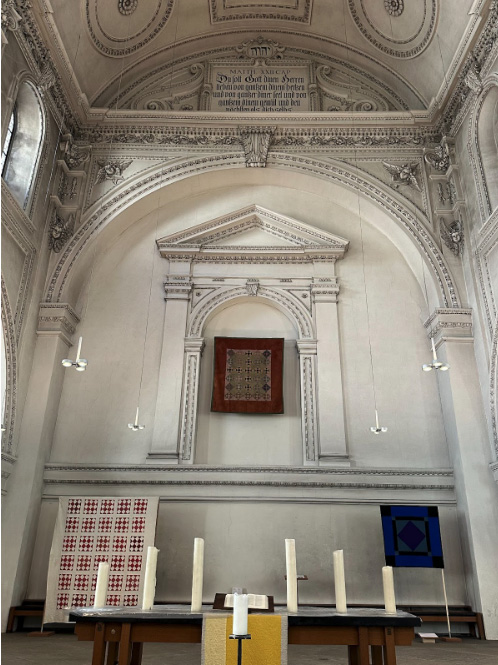
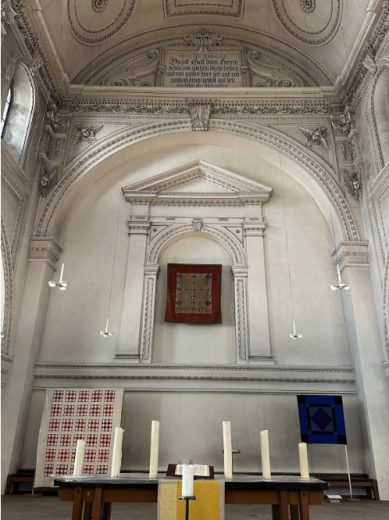
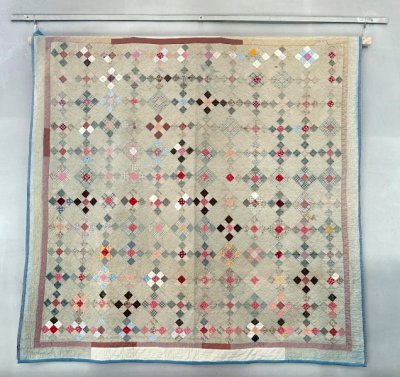
The witness of active love. In a church (the Predigerkirche) in Zurich, we encountered an exhibition about Mennonites in the Netherlands and the United States who stitched and sent quilts to comfort and assist 20th- century refugees from Russia and Ukraine. In this century, women in Switzerland picked up the tradition. They cut fabric squares and began to make refugee comforters, following the guidance of the Mennonite Central Committee. The work spread from homes to churches to larger facilities, growing to nearly 40 groups across Europe by 2025. This movement brings together Mennonites and diverse Europeans to create quilts in solidarity and care for refugees.
The witness of reconciliation. In Schleitheim, we met Reformed pastor and historian Doris Brodbeck and her husband, who pastors the local parish. When they moved to Schleitheim 17 years ago, Doris learned about the Anabaptist leaders who came together in that small town near the Swiss-German border to create the Schleitheim Confession, which was the first effort of Anabaptists to disseminate how to live out their faith. (At the local museum, we saw one of the two extant copies of an early edition of that confession. The other copy is at Goshen College, in the Mennonite Historical Library.)
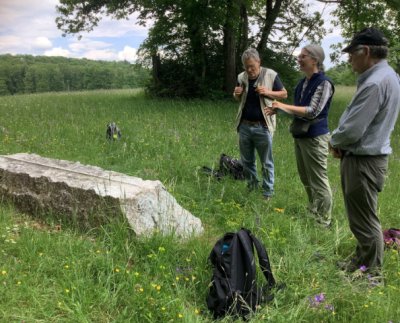
Doris was inspired to organize an ecumenical group of civic leaders to create the Anabaptist Path (Täuferweg) that ascends from Schleitheim, tracing the forested routes that Anabaptists used as they fled arrest. At the top of a hill, surrounded by a meadow of wildflowers, is the Täuferstein (Anabaptist Stone), a granite sculpture that honors the legacy of Anabaptists in Schleitheim, including Michael Sattler. Doris is not an Anabaptist, but she is working to ensure that the Anabaptist story and witness are known and honored today.

The witness of peacemaking. In Rottenburg am Neckar, where Michael Sattler and his wife Margaretha were imprisoned and executed, Lutheran leaders who were inspired by the peace position of the Anabaptists advocated and organized to install a massive granite stone that commemorates Michael and Margaretha’s witness at the site of Michael’s death.
On the anniversary of his death, the German Mennonite Peace Committee awarded the Michael Sattler Peace Prize to the Israeli-Palestinian organization COMET-ME in a ceremony held at Roytrngurg’s Lutheran Church. Director Asmahan Simry accepted the award, speaking about the group’s efforts to develop sustainable, off-the-grid energy, water and internet in communities of the West Bank. COMET-ME is supported by the solidarity and advocacy work of Goshen College graduates David ’11 and Sophie Lapp Jost ’13, who live with their two children in a multigenerational Mennonite community in Bammental, Germany. David and Sophie are supported by College Mennonite Church, and Sophie is the pastor of the Bammental Mennonite Church.
In this time of angst and division, it is beautiful to see how the life and witness of Anabaptists continue to evolve and reveal the love of Christ through people of diverse traditions. The Anabaptist story is still being composed. May my life, and the life of Goshen College, be a part of this creative work of the Gospel.
Rebecca Stoltzfus
 President's Blog
The Celery Lady tries to be a better human
 President's Blog
About nations and kingdoms
As we celebrate the birth of this nation 250 years ago, to be followers of Jesus is to be a community of loving and liberating people, whose only weapon is love.
 President's Blog
My word for 2026
I am learning eagerly and rapidly about AI and how it might change our work at Goshen College for the good. At the same time, I want to bring into clear focus what it means to be human. At GC, we are followers of the way of Jesus, who was God expressed in human form: born into a body, living among us and experiencing physical death. My word for the year is human.