

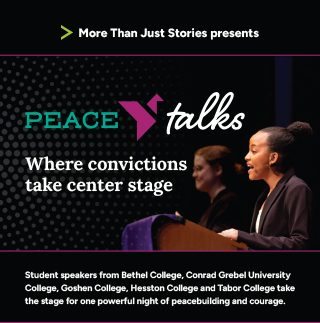
Peace Talks, an inaugural speech contest hosted by Goshen College, will invite students representing five Mennonite/Anabaptist colleges to compete on the same stage for the first time. As a project of More Than Just Stories, Peace Talks is a new…

News
Senior Isabel Massud wins 2026 Peace Oratorical Contest
Feb 18 2026

The finalists at the 2026 oratorical competition. From left: Isabel Massud, Angelica Garcia-Ponce, Caoimhe Farrell, Shalom Solomon Teferi and Mackenzie Miller.
Isabel Massud, a senior film production major from São Paulo, Brazil, won the 2026 C. Henry Smith Peace Oratorical Contest with her speech, “Gender Safety: An Illusion of the Free World.” Caoimhe Farrell, a sophomore communication major from Galway, Ireland, took second place.

Massud spoke about the normalization of gender violence in our culture, saying, “While we publicly condemn domestic violence, we continue to praise it indirectly through tradition, social norms, and the way we raise our children.”
“We call ourselves the free world,” she said. “But free for who?”
Her speech touched on how our society reinforces domestic violence, before calling for specific steps to enact change: widespread accountability, specific gender-conscious education, and parenting with a focus on gender equality. “If we want a future without violence,” she concluded, “it must begin with how we raise our children today.”

Farrell’s runner-up speech, “Screens and Society,” began with the line: “Since the moment I received my first phone, a hand-me-down Nokia, my parents have always told me, ‘It’s that damn phone.’”
In the next eight minutes, she argued that we are losing the things that make us human — connection, intimacy, communication skills — because we are, more and more, building our lives around technology instead of each other. “I fear that my future children will reach for a screen before they reach for me,” she said. Farrell concluded by saying, “Audience, I beg you to turn off your phone and live. Without turning it off, our oblivion to society surrounding us will make history.”
Three other finalists also spoke: Angelica Garcia-Ponce, a junior social work major from Warsaw, Indiana; Mackenzie Miller, a junior communication major from Harrisonburg, Virginia; and Shalom Solomon Teferi, a sophomore biochemistry/molecular biology major from Addis Ababa, Ethiopia.
Garcia-Ponce’s speech, “Silence Is Not Peace for Immigrant Women,” was dedicated to her mother. In it, she shared how she had seen her own mother survive domestic violence as an immigrant, and spoke about the dangers that immigrant women face, calling upon the GC community to take action and work with local organizations supporting people in these situations. “What kind of peace are we really giving people,” she asked, “when only those with papers are safe?”
Miller spoke of the overwhelming frustration and anger many hold in today’s society in her speech, “But What Can I Do?” She told the audience that despite their anger, we all must start by building relationships and connecting with peacemaking work in our own way. “I am angry at the systems of violence we live in,” she said, “but I’m not helpless. Not when our resistance is collective, nonviolent and driven by radical love.”
In “Healthcare as a Foundation for Peace,” Solomon Teferi spoke on the radical inequality in access to healthcare across our world, through a story of her mother’s misdiagnosis of cancer while she only had an infection. She dreams to become a doctor and help build a more just, peaceful world, saying, “I dream of a world where a child gets a vaccine, a mother gets the right diagnosis, and a neighbor knows they can see a doctor without fear.”
The panel of judges for this year’s competition was composed of Dr. Regina Shands Stoltzfus, professor of peace, justice and conflict studies at Goshen College; Allan Rudy-Froese, associate professor of preaching and voice at Anabaptist-Mennonite Biblical Seminary and adjunct professor at Conrad Grebel University College; and Amanda Guzman, communications professional and marketing and community engagement specialist at Interra Credit Union.
The C. Henry Smith Peace Oratorical Contest, sponsored by the U.S./Canada Mennonite Central Committee, provides students with a platform to engage in meaningful discourse and advocate for peace. The contest honors the legacy of C. Henry Smith, a revered Mennonite historian and professor, by empowering students to develop their rhetorical skills and contribute to the cause for peace.
 Articles
Five college contestants to compete in inaugural Peace Talks
 Articles
Goshen College announces Spring 2025-26 Dean’s List
Goshen College recently recognized 166 undergraduate students for excellence in academics on the 2025-26 spring semester Dean’s List.
 Articles
Women’s tennis earns first-ever NAIA tournament win
The Goshen women's tennis team set another first in program history on Tuesday evening — their first-ever national tournament win.