

To be human is to become visible
while carrying what is hidden as a gift to others . . . .
You are not a troubled guest on this earth,
you are not an accident amidst other accidents
you were invited from another and greater night
than the one from which you have just emerged.

News
My word for 2026
Jan 11 2026

My mother, Marie Stoltzfus, holding her new great-grandchild over Christmas break.
By Rebecca Stoltzfus, president for “President’s Blog: Distinctively Goshen”
The new year begins within the liturgical season of Christmas, and I have been lingering in the Nativity story. “The Word became flesh and dwelt among us.” God loved the world so much that God became human.
Then came the pivot back to work, as I attended an institute for presidents of private colleges. Numerous sessions focused on the transformative potential of artificial intelligence (AI). It is mind-stretching to hold these realities together: God expressing Godself as a human baby, while human creativity, language and imagination are being aggregated, abstracted and transformed into computer code.
I am learning eagerly and rapidly about AI and how it might change our work at Goshen College for the good. At the same time, I want to bring into clear focus what it means to be human. At GC, we are followers of the way of Jesus, who was God expressed in human form: born into a body, living among us and experiencing physical death.
My word for the year is human.
If God so loved the world, being human is to be cherished. What might that mean?
To be human is to embrace imperfection—in myself and others. Our lives are short, vulnerable, interdependent and lived in bodies. The raw core of vulnerability within each of us gives rise to connection, love, longing and creativity. Over the holiday break, sixteen descendants of the Stoltzfus clan gathered with my parents, and while we were together, my niece gave birth to a baby! Our gathered family spanned four generations, from one day to ninety-two years old. Every person, every body, is uniquely vulnerable and deeply interdependent.
To be human is to recognize that our embodied physical presence matters. We attend to one another physically—in conversations, kitchens, classrooms and churches. Our presence matters. Humans feel one another, emotionally and bodily. In a world that has become increasingly transactional, how might I attend to each human interaction with greater intention and kindness? Let us not squander the gift of our presence. And most of all, let our presence be a source of encouragement for those we encounter.
To be human is to claim what we are worthy of in this world. We are worthy to be seen and heard, to be treated with dignity, to create and express, to act with moral agency, to love and be loved. Our shortcomings, fears and embarrassments can be doorways to growth if we live into the true inheritance of our belovedness. As the poet David Whyte writes in the poem, What to remember when waking:
To be human is to experience transcendence beyond the self. A hawk may not experience transcendence as it soars, but we do, beholding it and empathically experiencing a lofty view of the world. Humans cultivate transcendence through contemplation, through deep stillness or through awe as we glimpse vastness or beauty. Astronauts describe being profoundly changed by the view of Earth from space, an experience they call the overview effect. In the words of astronaut Ron Garan, “We are the universe becoming conscious of itself.”
Yet we need not go to outer space to experience transcendence. We can cultivate it in our daily life—in the subtle shift of awareness that reveals life as sacred, and ourselves as intimately and inextricably part of that sacredness. The writer and monk Thomas Merton described such a moment:
“In Louisville, at the corner of Fourth and Walnut, in the center of the shopping district, I was suddenly overwhelmed with the realization that I loved all these people, that they were mine and I theirs, that we could not be alien to one another even though we were total strangers. . . . This sense of liberation from an illusory difference was such a relief and such a joy to me that I almost laughed out loud. . . . I have the immense joy of being man, a member of a race in which God Himself became incarnate. As if the sorrows and stupidities of the human condition could overwhelm me, now that I realize what we all are. And if only everybody could realize this! But it cannot be explained. There is no way of telling people that they are all walking around shining like the sun.”
May 2026 be a year in which we devote ourselves to the humanization of ourselves and others, in rich and meaningful ways. It is an extraordinary blessing to be invited into flesh, relationship and our inherent worthiness for these short years. Let us cherish our humanity—in ourselves and in one another—and embrace it fully.
P.S. Curious about my prior words of the year? You can read those posts here:
 President's Blog
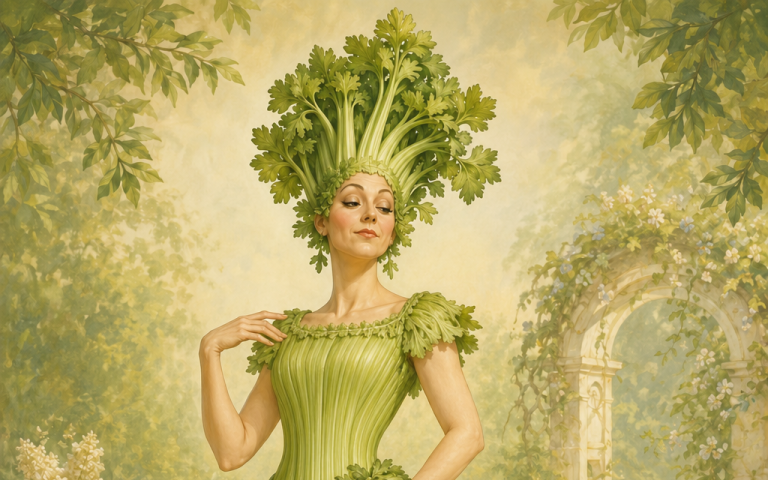
The Celery Lady tries to be a better human
We are in a big social experiment with technological replacements for real human service. I waver on the emotional knife edge, and sometimes I add to the inhumanity. But I realize that there is another choice. What if each time I encounter technology replacing human customer service, I would choose to create a new and positive interaction with someone?
 President's Blog
About nations and kingdoms
As we celebrate the birth of this nation 250 years ago, to be followers of Jesus is to be a community of loving and liberating people, whose only weapon is love.
 President's Blog
A Christmas meditation: The Bottom-Up Kingdom
I would like a top-down God. What Christmas offers us instead is a bottom-up God.