

Goshen College recently recognized 166 undergraduate students for excellence in academics on the 2025-26 spring semester Dean’s List.

News
Career Pathways in the Humanities
Apr 15 2026
For years, the question has followed humanities students:
What are you going to do with that?
It’s a fair question, if an incomplete one. Critics of the liberal arts have long pointed out that while an English major might graduate with sharper critical thinking or a history major with an enviable ability to construct an argument, the line between diploma and paycheck is not straight. What actually does one do with an art history major if teaching high school isn’t the plan? How do you find stable work in music if you’re not in the top one percent of performers? Where does a history degree lead besides the classroom, with a side gig coaching football?
Advocates of liberal arts education have always answered by pointing to transferable skills — critical thinking, communication, civic engagement, cultural awareness. And those defenses aren’t wrong. But several departments at Goshen College have decided that a spirited defense isn’t enough. Instead, they’ve gone on offense, redesigning their curricula to embed clear career pathways directly into the major. Students aren’t left to connect the dots themselves — the dots are already connected.
Here’s a look at what that means in practice across campus — in the art, theater, library science, English, Spanish and criminal and restorative justice departments.
Art: Post-grad planning from the start
Many art programs treat professional development as an afterthought bolted onto the end of a senior year. Goshen’s art faculty have taken a different approach, tailoring each student’s schedule and focus for their particular post-grad goal.

Method
Sara Method, professor of art, described an advising model that starts with a student’s long-term goals and works backward from there. “What are you even considering that you might want to do?” she asked. “And so, from that, we try to work backwards.”
The result is a set of concentrations — art entrepreneurship, studio art, pre-architecture, pre-art therapy, and art education — each built with specific destinations in mind. The pre-art therapy concentration, for example, was designed by examining the entrance requirements of graduate programs and then building those prerequisites directly into the concentration. For the students, Method said, “when you get to grad school, you’re ahead.”
The art entrepreneurship track took a similar approach, with art faculty consulting marketing colleagues to identify which business courses would most help a student trying to open a small business. Students will learn how to brand themselves, how to approach digital and social media marketing, and much more.
Finally, once art students reach their junior or senior year, they take a redesigned art seminar that is explicitly focused on career and graduate school readiness. Students find an actual job posting and tailor their resume, cover letter and portfolio to it. They practice how to frame their experience in professional language and write an artist statement. Additionally, they learn in-depth about how to apply to artist residencies and internships, setting them up for success beyond the graduation stage.
Theater: Careers on and off the stage
Amy Budd, professor of theater, has a direct vision for the theater major: students should leave Goshen ready to work, instead of waiting for a graduate program to finish what their undergraduate education started.

Budd
Students now define their specialties through upper-level electives of their choosing and production work, making it easier for students to double major or join the program later in their college careers. The goal, Budd said, is for the curriculum to “help students launch into the workplace in a way that’s fully formed,” turning students into adaptable professionals ready for opportunities in live entertainment and events industries as well as traditional theater.
Budd also pushed back against the assumption that the path to professional credibility needs to run through graduate school. “Going directly from undergrad to graduate school does not give you the chance to develop that intentionality,” she said. “Our goal is for you to move into the world — and if you choose to get future education, you are well prepared for that. But if you choose to keep working, you are able to grow and adapt and function in a fast-paced, changing environment.”
Her broader philosophy is that the specifics of the credential itself matters less than the person holding it. “My professional experience teaches me that your minor or concentration is not important to employers,” she said. “Your capacity to learn, take direction, and self-motivate are a lot more important than particular sequences of courses.”
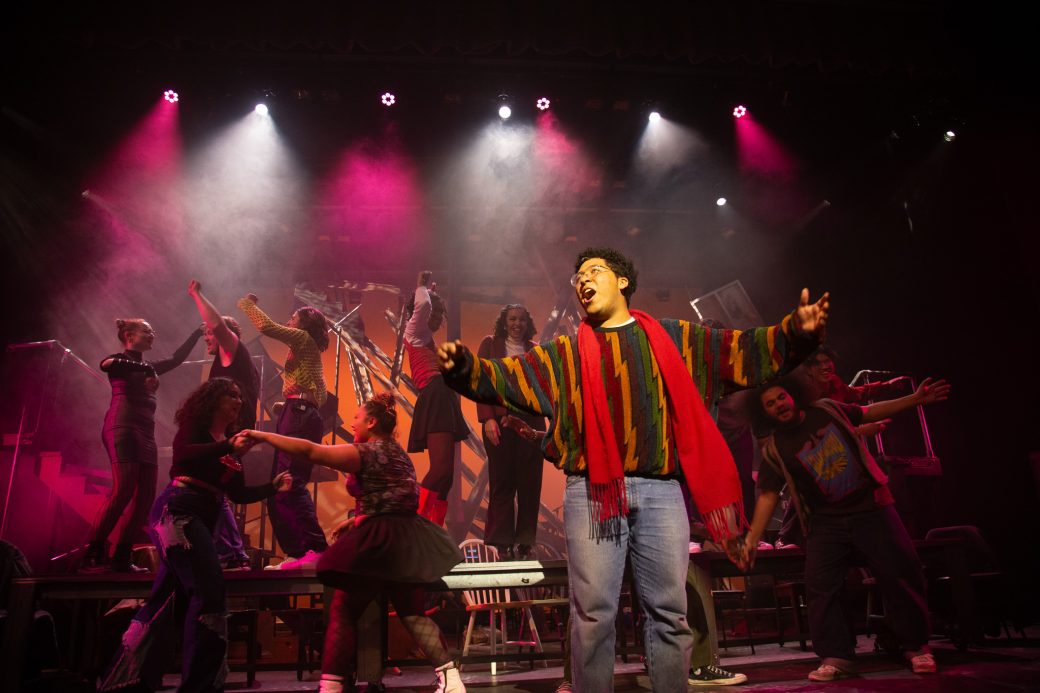
Students not only explore on-stage roles in theater productions, but also the full picture of what a career in the performing arts may look like.
Library Science: Career-focused additions alongside majors
Fritz Hartman, library director, and Angie Fisher, head of research and instruction, didn’t originally plan to build the only undergraduate library science program of its kind in Indiana. But recent changes to Indiana State Library credentialing created a gap, and Goshen College stepped in to fill it.

Hartman
The Library Science certificate works, in part, because of how Indiana credentials librarians. If students take library science courses in college, they can get better credentials for job applications — meaning they will exit college prepared for the workplace. The brand-new program gives students the skills and classes they need to qualify for specific roles in the library immediately upon graduation. Students of any major can earn this certificate, meaning that student demand is already quite high.
The program’s foundational course, Foundations of Library Science, is designed to demystify the profession — introducing students to how libraries function, how they talk to one another, and what working in one actually looks like day to day. For students considering graduate school in library science, or planning to work in libraries immediately after graduating, that grounding matters. “Just having that baseline knowledge will help students tremendously,” Hartman said. In either situation, without this knowledge, “it can be intimidating never having worked in a library before, not knowing what terms like ‘circulation’ or ‘acquisitions’ mean within the library context.”
Writing and Publishing: English with a twist
The English department’s writing program has a new name, Writing and Publishing. Along with that comes a sharper sense of where graduates are headed. At the center of the redesign is a new course in editing and publishing, which brings the operations behind two of the department’s longtime programs — Pinchpenny Press and Broadside, both running since the 1970s — more formally into the curriculum. Students gain hands-on experience in editing, disseminating and publishing a wide range of content, from trade books to grant proposals to corporate communications.

Baldanzi
A partnership with Short Stack Letterpress in downtown Goshen adds another layer of applied experience. “Turning your writing into art makes you think differently about every single word and letter,” said Jessica Baldanzi, professor of English.
The department also sees the rise of AI-generated writing as an unexpected asset for its graduates. “Editing skills are going to be increasingly important, as AI generates more and more content,” Baldanzi said. “People are going to be looking for authenticity.” Editing and refocusing weak, illogical or factually inaccurate computer-generated text requires exactly the kind of high-level intellectual work the major develops — positioning Writing and Publishing students as particularly well-suited for an evolving content landscape.

Students gain hands-on experience in various ways of creating the written word, including working with this letterpress in downtown Goshen.
Spanish: Communicating throughout community
The Spanish department’s curricular pivot started with a straightforward observation: the region surrounding Goshen has a significant and growing Spanish-speaking population, and bilingual professionals are in high demand. Cristobal Garza Gonzalez, professor of Spanish, described the department’s approach this way: “We were thinking, how can we offer more practical skills for students? So we incorporated interpretation because, particularly in this area, there’s a lot of need.”

Garza Gonzalez
So, the department revised the curriculum to include a course in community interpretation and translation, and opened the door for students to serve in local schools, clinics, and other community organizations. In their community interpreting class, students will spend 40 hours during the semester serving with an organization where they will use their Spanish skills. Many students also spend time working with organizations outside of the core curriculum, helping interpret across Elkhart County.
Another professor, Terry Martin, is developing a course in English-Spanish interpretation specifically for the medical field — a logical extension given the linguistic overlap between Spanish and medical terminology. “It’s easy to understand medical text or speech if you know Spanish,” Garza Gonzalez said.
The shift reframes what it means to be a Spanish major. As Garza Gonzalez put it, students are now already entering professional settings “as somebody who has a knowledge and skill to offer to make their situation work well.”
Criminal and Restorative Justice: Values and vocation
While not truly a humanities course, the relatively new Criminal and Restorative Justice program occupies a distinctive space on campus — one where Goshen College’s deep commitment to peace and social justice meets the practical demands of professional preparation. For Robert Brenneman, professor of CJRJ and sociology, that combination is precisely the point.

Brenneman
CJRJ, he said, is designed as a program that “allows students to imagine a pathway from college into a stable and interesting career.” And students don’t have to just imagine it; they see it in practice in their time at GC.
The program builds connections deliberately and at every level. Practitioners from the community come into the classroom to speak to students — county judges, probation officers, state police officers, even the FBI. Additionally, second-year students are required to observe the justice system directly — visiting a jail, spending time at a home for developmentally delayed adults, attending a treatment court — so that the connections between ideas and careers are clear. By senior year, internships are, as Brenneman described them, “strategically chosen, tailored to the talent and passion of each senior.
“Some students find their calling during their internships,” he said. “Many discover a possibility and make connections. But that internship, I’m convinced, is the most valuable thing they get.”

One popular CJRJ course that expands the classroom is the Inside-Out course, held at the Elkhart County Correctional Complex.
The Full Picture
Taken together, these curricular changes reflect Goshen College’s conviction that a liberal arts education and professional preparation aren’t in tension. The skills developed in humanities classrooms are valuable in the world, and students deserve a curriculum that makes that case clearly and tangibly.
The question, What are you going to do with that? hasn’t gone away. But at Goshen College, more and more departments have a very specific answer ready.
 Articles
Goshen College announces Spring 2025-26 Dean’s List
 Articles
Women’s tennis earns first-ever NAIA tournament win
The Goshen women's tennis team set another first in program history on Tuesday evening — their first-ever national tournament win.
 Articles
Commencement 2026 Speech (Full Text): ‘Two Buckets’ by Shannan Martin
Read Shannan Martin's message to the Goshen College Class of 2026, "Two Buckets."