|
Stereotypes and Divergent Thinking
Nurturing divergent thinking
in studio art classes
© Marvin Bartel 2001 - 2008
author bio
What
happens to our creativity as we mature?
84%
rank
high in creativity in Kindergarten
10%
rank high in creativity in grade 2
from:
Robert
McGarvey “Creative Thinking” USAIR, June 1990, p. 36
-------------------------------------
The following is from the web site of the United Kingdom Literacy Trust, November 6, 2005
From Glasgow, A conference in March, 2005, by the Scottish Book Trust,
I quote:
"Sir Ken Robinson, chair of the UK Government's report on creativity, education and the economy, described research that showed that young people lost their ability to think in "divergent or non-linear ways", a key component of creativity. Of 1,600 children aged three to five who were tested, 98% showed they could think in divergent ways. By the time they were aged eight to 10, 32% could think divergently. When the same test was applied to 13 to 15-year-olds, only 10% could think in this way. And when the test was used with 200,000 25-year-olds, only 2% could think divergently. . . . Education is driven by the idea of one answer and this idea of divergent thinking becomes stifled.' He described creativity as the 'genetic code' of education and said it was essential for the new economic circumstances of the 21st century." signed: (TESS, 25 March 2005)
source - http://www.literacytrust.org.uk/Database/thinking.html#wither
Copyright © National Literacy Trust 2008 (UK)
The above quote is from 2005
This link was last checked on 23 August 2008, and the above statement was still posted.
Listen to this creative YouTube talk: "Do schools today kill creativity?" by Ken Robinson
It has been viewed 384,744 times as of October 9, 2008
http://www.youtube.com/watch?v=iG9CE55wbtY
What
are the reasons children become less creative
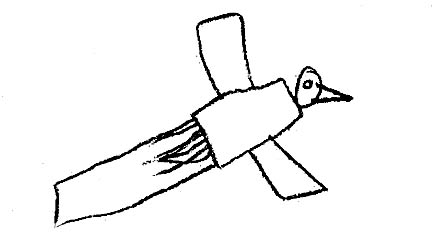
Above
is a child's bird drawn from experience and memory

This
child is asked to color workbook birds for math (above)
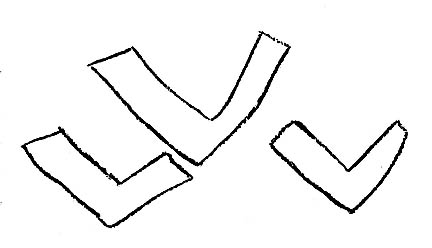
Birds
drawn by this child after the stereotyping effects of the workbook
These illustrations are taken from: Viktor
Lowenfeld and
W. Lambert Brittain.
Creative and Mental Growth, 6th ed.
1970.
Macmillan, NY. p. 109
REVIEW of Practical Recommendations
for avoiding this loss of creativity.
How do I, as an art
teacher
work at nurturing a culture of divergent thinking in studio artwork?
- I avoid using stereotyping drawing
guide books, drawing formulas (number of heads in a body), patterns,
coloring books, dot to dot games, etc. In our family, our kids had lots of art materials, but no coloring books. They colored within lines that they created.
- I encourage
work from real experiences, observations, and imagination, not from imitation ? Experiences are remembered. Observation
simply means that children can look at things and learn to draw them.
Imagination is the unique ability that makes us human. Animals
imitate. Children imitate things to learn uncreative stuff and they
imagine things to practice being creative. Children can color their
own drawings to develop their fine motor skill - no need to give them
coloring books?
- I
provide ample materials and blank
paper, not workbooks and coloring books?
- I motivate with
open questions
questions to encourage innovation. An open questions has
more than one answer. Often
I say, "This part is good. Is there anything else that your picture
needs?" This is a very open question that asks for thinking.
- I ask "thinking" questions - I do not make suggestions - I do not draw for the child.
To remind a child to include ears, I do not say, "Does your girl need
ears?" A thinking question would be, "What kind of music does
your girl like to listen to? How can she hear the music?"
I do not ask, "Does the face need a mouth? I ask, "What is the best
tasting vegetable? How does your boy eat it?" Artwork is owned by the artist who comes up with the ideas. Questions, not suggestions, allow this ownership based on observing, on experiences and on the imagination.
- I encourage
children to be choice makers. I
have child decide what their work needs. If a child asks
me for help, I help by asking the child to give me several of her
ideas. Then I say that these are good ideas, and ask her which one
she likes best.
Also #8 below.
- I encourage
practice-practice-practice while coaching to improve practice techniques and to make the hard stuff easy enough so that discouragement does not set in. I try to make learning hard enough to be challenging (not boring), and easy enough to avoid total frustration.
- I encourage experimentation
as learning. Instead of showing how something is done, I ask them
to try it several ways (maybe on another piece of paper). I then ask
the the child to select the best idea or discovery that comes out of experimentation. I remain open
to and encourage fresh ideas from children. Even when I think something will not work, it is often better to encourage a child to learn from experience rather than to extinguish the experiment before it starts.
- I affirm and
celebrate mistakes as learning. The lack of mistakes is
an indication of "playing it too safe." Many new ideas emerge
from mistakes and solutions to mistakes. Both art and science are filled with important discoveries that began as mistakes. A Wikipedia search of the word "serendipity" lists many such examples. As teachers, we make a mistake when we penalize mistakes rather than help students make discoveries from them. Too often we teach children to fear mistakes rather than discover what can be learned from them.
- To build awareness I focus attention
to visual detail such as texture, proportion, counting parts, color changes,
tonal changes, and so on during observation and during experiences
even when the child is not actively drawing. This can happen in many
places such as a nature walk, looking at buildings, studying toys,
visiting an animal, and so on. I use lots of questions. Later, when
drawings are done, they include much more.
- I ask for careful
attention to experiences. I ask lots of awareness questions about what we are seeing, touching, smelling, tasting, hearing, etc. Drawings and life will be richer. I ask for conclusions
from observations. Review with emphasis on child’s
own observations and experiences. Ask, "How could you draw, paint, or model this?"
- I emphasize
the importance divergent approaches by changing
habits of work. "Where do you like to start your
drawing? What happens when you start it at a different place?" "What if you start with the background?" "How is it different when you plan the arrangement of things than when you just start with what is most important?" What does
this say about freedom? It generally means that assignments must have new requirements and limits, but it does
not show a model to follow.
- I encourage creative peer interaction where children are coached to cooperate and compete with peers in demonstrating divergent thinking and outcomes. I use games activities that give points or positive feedback for unique ideas and expressions rather than copying and mimicking each other. I coach children to ask each other questions as they help each other learn to do new things.
- I encourage
the "What if". . . . . ." questions and use the
"Try it." answer.
Workbooks and coloring
books are probably a fairly small part of the issue. What other possible
reasons are there for the huge drop in divergent thinking ability from Kindergarten
to grade two? Human instinct and normal development may be largely responsible for our drop in divergent thinking as we mature. Does this excuse us when we teach in ways that reward copying and minicking rather than letting kids know the secrets and strategies that highly creative people use when they think.
What are other
possible reasons there are fewer
creative children in second grade than in kindergarten? Before reading my list, what if you jot down your list? What if you try out your own divergent thinking and see what your list looks like? This is my list.
Bartel HOME PAGE for Art Education
Topics | back
to AfternoonSabbatical.html
Bartelart.com Art
Department Bartel
Courses Marvin
Bartel Home Bartel
Artwork
last update 8-23-08
All rights reserved. © Marvin Bartel. 2001. contact the author
|